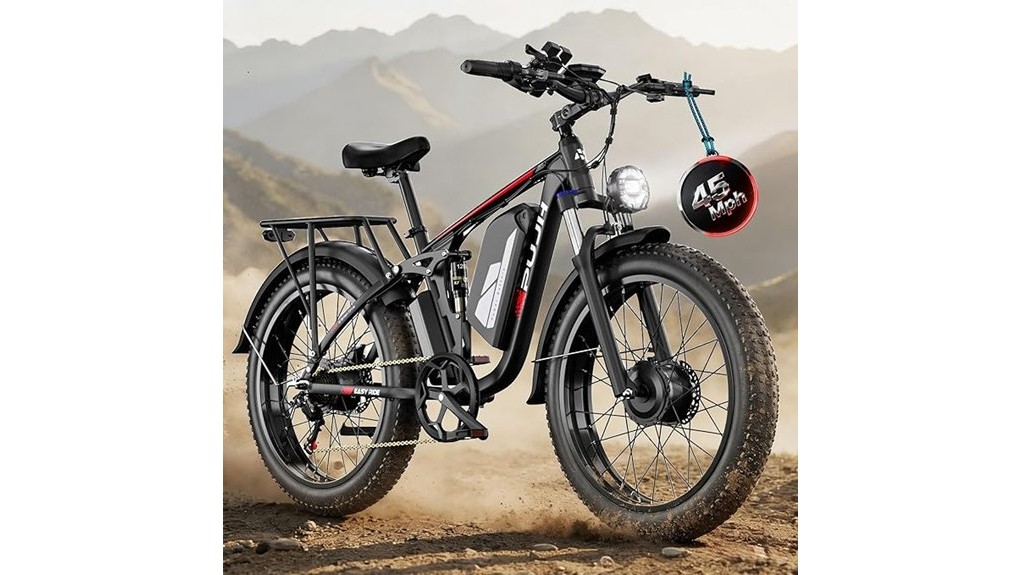

You’ll get immediate, high‑torque acceleration from dual 6000W peak motors and a certified top speed near 45 MPH, but range and handling suffer under heavy use and payload. The 60V/1200Wh pack gives higher continuous power with less thermal stress than 48V systems, yet real range falls far below conservative 100–110 mile claims if you push throttle or dual‑motor mode. Brakes, suspension, and legal limits matter; keep reading for detailed trade‑offs and setup tips.
Some Key Takeaways
- Dual brushless motors claim 6000W peak and deliver immediate, high-torque acceleration with crisp throttle response.
- Top speeds around 45+ MPH are achievable in dual-motor mode under favorable conditions and light assist.
- Real-world range varies widely from manufacturer claims, dropping significantly with high power use, payload, or rough terrain.
- 60V/1200Wh battery provides strong continuous power and lower thermal stress versus 48V systems.
- High-speed capability demands robust brakes, safety gear, legal checks, and potential speed-limiting for controlled use.
Real-World Performance: Speed, Range, and Power Delivery for 6000W Dual Motors
When you push the PUJH PU364’s dual brushless motors, the bike delivers immediate, high-torque acceleration—up to a claimed 6000W peak and roughly 200 Nm—so you’ll feel strong off the line and on steep grades; in practice expect sustained top speeds around 45+ MPH in favorable conditions with dual-motor mode, while single-motor operation lowers both acceleration and top speed. You’ll notice linear torque delivery and crisp throttle response compared with typical mid-drive e‑bikes, though range drops under high-output use. Expect claimed 100–110 mile figures only at conservative assist levels; heavy throttle, payload, or terrain will reduce real-world range markedly. For riders who enjoy outdoor activities, choosing the right setup and components for adventure riding can make the most of the PU364’s capabilities.
Ride Quality and Off‑Road Capability: Suspension, Tires, and Handling
Although the PUJH PU364 pairs hefty motors with robust geometry, its ride quality on rough terrain hinges on the suspension tuning and fat‑bike tire contact patch. You’ll feel fore/aft stability from the 6061 frame, while 7-level suspension tuning lets you dial rebound and compression for trail or sand. The 24″ x 4.0″ tires widen the contact patch, boosting Tire traction on loose surfaces and smoothing chatter on rocky sections. Handling compares well to similar heavy e‑bikes: steering is stable but slower to flick. Expect compliant seatpost travel and firm rear shock settings for load‑carrying or high‑speed cornering. This setup is ideal for riders who enjoy all‑terrain riding and outdoor adventures.
Battery, Charging, and Practical Range: What 1200Wh and 60V Mean in Use
A 60V, 1200Wh battery gives you a high-voltage platform and substantial energy reserve that translate into stronger motor efficiency and longer potential range compared with typical 48V systems. You’ll see higher continuous power delivery with reduced current for equivalent watts, lowering thermal stress. Practical range depends on throttle use, dual-motor mode, payload, and terrain; manufacturer claims 100–110 miles feel optimistic under mixed off‑road loading. Check battery chemistry for cell stability and cycle life—likely lithium‑ion. Follow conservative charge practices: avoid full discharge, store at ~40–60% for long periods, use the supplied charger, and monitor temperature while charging. For riders who enjoy outdoor activities, maintaining proper storage and charging habits helps keep your ebike battery healthy and ensures reliable performance on adventures.
Safety, Braking, and Legal/Use Limitations at 45+ MPH
Having a high-capacity 60V, 1200Wh pack improves motor efficiency and range, but it also raises safety and braking demands once you push speeds above 45 MPH. You need rated protective gear and must verify helmet requirements for high-speed e-bikes in your jurisdiction. Dual hydraulic discs provide stopping power, yet effective brake modulation is critical to avoid lockup on fat tires at speed. Consider electronic speed governors or selectable single-motor mode for controlled testing. Also weigh licensing implications, insurance, and roadway restrictions: some regions classify 45+ MPH e-bikes as mopeds or motorcycles, altering legal use and required equipment. Riders should also consider tracking and insurance designed for ebike theft recovery and rider protection.
Who Should Buy This Bike and How It Compares to Alternatives
If you need a high‑torque, long‑range fat‑tire e‑bike for mixed off‑road and commuter use, this PUJH PU364/PU3 suits riders who prioritize powerful acceleration and extended range over lightweight portability. You’ll benefit if you require commuter suitability for longer commutes, robust cargo capacity, and all‑terrain traction. Compared with lighter urban e‑bikes, it sacrifices portability and nimble handling for 6000W dual‑motor performance, 1200Wh battery range, and full suspension. Versus mid‑powered fat‑tire models, it offers higher top speed and torque but adds weight and legal complexity at 45+ MPH. Choose it if you accept heavier mass for superior power. Riders who favor step‑through frames for easier mounting and dismounting will find this model aligns with many outdoor step-through riding needs.
Some Questions Answered
How Long Does the Removable Battery Take to Charge From 0% to 100%?
You’ll expect a full battery charge from 0% to 100% in about 4–6 hours per the manufacturer’s Battery charge time spec. Using the standard off-bike charger yields the quoted 4–6 hour range; Charging methods like fast chargers or parallel multi-battery systems can reduce time but may stress cells and void warranty. Compared to similar 1200Wh packs, this is competitive; slower trickle charging preserves longevity while rapid charging trades lifespan for speed.
Is the Bike Compatible With Racks or Child Seats for Cargo/Child Transport?
Yes — you’re rack compatible and can fit child seats, but check limits. The sturdy 6061 frame includes a solid cargo rack rated for typical panniers and cargo boxes; it’s rack compatible with standard mounts. For child secure transport, mounting points and the 330 lb max recommend using certified child seats and weight distribution checks. Compare seat options and rack load ratings; avoid exceeding payload or altering suspension/brake performance.
What Maintenance Schedule Is Recommended for Dual Motors and Hydraulic Brakes?
You should do a Weekly inspection for fluids, torque, wiring, motor temps and brake lever feel; clean and lube drivetrain and check hydraulic lines for leaks. Compare single- vs dual-motor load patterns and monitor both motors’ mounting bolts and phase connectors. Every 12 months perform an Annual overhaul: bleed brakes, replace fluid/seals as needed, open motors for bearing/brush checks, test battery health and recalibrate controllers. Keep detailed logs.
Are Replacement Batteries or Parts Readily Available in the U.S.?
Yes — you’ll generally find battery availability and parts in the U.S., but it’s mixed. OEM batteries and common wear parts are available through the manufacturer or third-party suppliers; aftermarket warranties vary. Compared to mainstream e-bike brands, sourcing specialized 60V/1200Wh packs and dual-motor components can be slower and pricier. You should confirm vendor support, read warranty terms, and compare lead times and compatibility before buying replacement batteries or parts.
Can the Bike Be Legally Registered or Insured as a Moped in My State?
Possibly — you can register or insure it as a moped only if your state’s license classification and local regulations treat high‑power e-bikes as mopeds or motorcycles. Compare your bike’s top speed, motor power, and throttle capability against state definitions; some states cap e-bike power or speed for moped status. Contact DMV/insurance with specs (6000W, 45+ MPH, throttle) to confirm requirements, fees, plate, helmet, and endorsement needs.