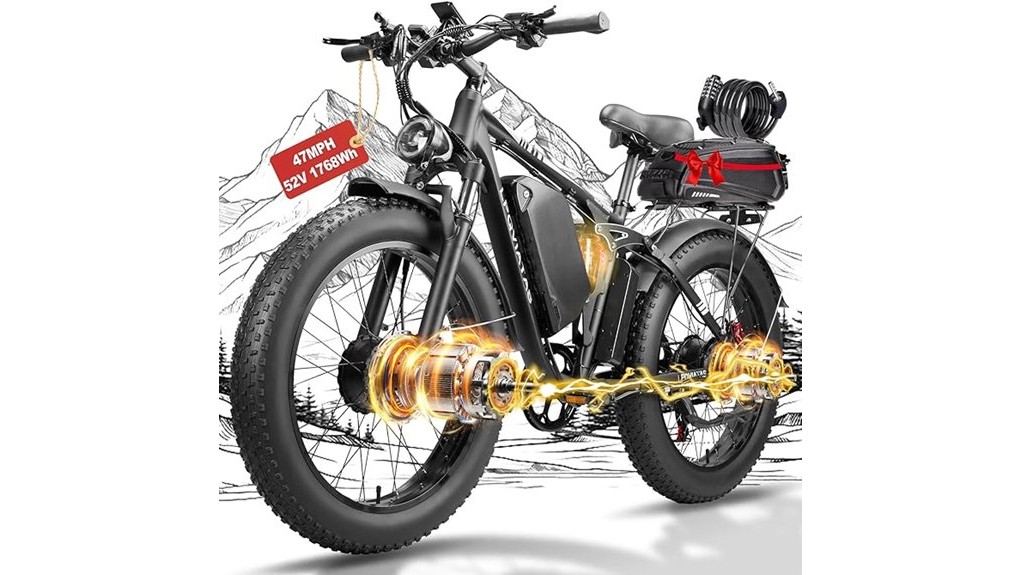

You get two 4,500W brushless motors giving a 9,000W peak burst and about 220 N·m combined torque for aggressive climbs and instant acceleration, though continuous output is limited by thermal management and controller current caps. A 52V 34Ah pack yields ~37 miles full‑electric or 90–105 miles with PAS. Full suspension, 24×4.0″ tires, and four‑piston brakes handle off‑road loads and steep grades; keep battery between 20–90% and expect routine maintenance to preserve performance—more technical detail follows.
Some Key Takeaways
- 9000W peak rating comes from two 4500W brushless motors delivering combined AWD performance with up to ~220 N·m torque.
- Real-world sustained power limited by thermal management and controller current limiting, affecting continuous climbs and long bursts.
- 52V 34Ah (1,768 Wh) battery yields ~37 miles pure-electric or 90–105 miles in PAS blended mode under typical conditions.
- Full suspension, 24×4.0″ fat tires, and four‑piston hydraulic brakes provide stable off‑road handling, traction, and fade‑resistant stopping.
- Ownership requires routine maintenance, battery care, accessories, and verification of local e‑bike regulations for legal compliance.
Performance and Power Breakdown: What 9000W‑Peak Dual Motors Actually Deliver
Although the 9000W peak rating sounds dramatic, what you actually get are two 4500W brushless high‑speed motors that deliver up to 220 N·m of torque in combined output and provide all‑wheel drive capability for sustained climbs and rapid acceleration. You evaluate sustained power by torque curves, thermal limits, and control algorithms. Peak bursts hit performance targets; continuous output depends on heat management, cooling design, and controller current limiting. You monitor motor longevity through duty cycle, bearing loads, and thermal cycling. You expect predictable degradation if you prioritize moderate continuous loads, conservative PAS settings, and routine inspections to preserve drivetrain life. The shop also offers compatible motor controllers and accessories tailored to outdoor ebike riders.
Battery, Range, and Charging: Realistic PAS vs Pure‑Electric Expectations
When you compare PAS and pure‑electric operation on this 52V 34Ah (1,768 Wh) pack, expect substantially different real‑world ranges: PAS modes extend range to roughly 90–105 miles by blending human power with motor assist, while full‑electric (dual‑motor) use drops range to about 37 miles under typical conditions. You’ll monitor real world efficiency via watt‑hour per mile; aggressive throttle and hills double consumption. Follow charging etiquette: avoid overnight top‑up and keep charge between 20–90% for longer life. Pay attention to thermal management during sustained high‑power runs to limit battery degradation and preserve peak capacity. Practice proper battery care to maximize lifespan when riding outdoors.
Ride Quality and Handling: Suspension, Fat Tires, Brakes, and Hill Climbing
Having covered how battery strategy affects range, let’s look at how the bike’s mechanical systems convert that energy into controllable ride feel. You’ll notice full suspension with a lockable dual‑crown fork and rear shock absorbs roughly 85% of impact, keeping wheel contact consistent during high‑speed runs. 24×4.0″ tires deliver predictable fat tire traction on snow, sand, and loose dirt, reducing slip even under AWD torque. Braking uses dual hydraulic stopping with four‑piston calipers and oversized rotors for repeatable fade‑resistant deceleration. Climbing up to 42° is stable thanks to torque distribution and suspension that maintains traction under heavy drive loads. These components are ideal for riders who enjoy outdoor activities and off‑road e‑bike adventures with all-terrain ebikes.
Who This eBike Is For and How the Six Operating Modes Change the Experience
If you need a high‑power, all‑terrain commuter or off‑road platform, this dual‑motor eBike suits riders who prioritize hill‑climbing, towing, or rapid commutes while retaining pedal options. You’ll appreciate its 9000W peak AWD for steep gradients and heavy loads; urban commuters gain sprint ability and traffic‑safe overtakes, while riders on long tours get PAS range efficiency. Mode selection tailors energy use: Walk for maneuvering, PAS for extended range, Dual‑motor pure electric for max torque, Single‑motor pure electric to conserve battery, Bike for integrated assist and cadence, Manual for full rider control. Modes alter feel, range, and braking load. Riders should also carry essential trail gear like a multi-tool, spare tube, and protective helmet for safer off‑road adventures.
Ownership Checklist: Accessories, Maintenance, Legal/Safety Limits, and Final Buying Verdict
Because this eBike pairs extreme power with street-legal gray areas, you’ll want a focused ownership checklist before you ride: verify required accessories (helmet, mirrors, lights, horn, cargo restraint), confirm local classifications and speed- or power-related licensing/insurance rules, budget for routine upkeep (brake pad and rotor replacement intervals, drivetrain derailleur tuning, suspension service), plan battery care and storage procedures, and acquire tools/spares (torx/allen set, spare tube/patch, motor connector cleaner) to keep downtime minimal. Follow this accessory checklist, set service intervals based on usage, document battery charge cycles, and validate legal considerations. Verdict: buy only if you accept complexity, maintenance, and regulatory risk. Also consider investing in a high-quality U-lock choice specifically rated for outdoor eBike use to protect your investment.
Some Questions Answered
Is the Battery Removable for Airline or Transport Compliance?
Yes — the battery is removable. You can detach the 52V 34Ah lithium pack for transport, which helps address airline compliance concerns. However, airline compliance depends on Watt-hour limits and carrier rules; this battery is 1768 Wh, well above typical airline allowances, so you won’t meet most airline policies for checked or carry-on lithium batteries. You’ll need special permits or alternative shipping arrangements for air transport.
Can the Motors Be Upgraded or Tuned via Firmware?
Yes — you can tune motors via firmware, but proceed carefully. You’ll perform firmware flashing to alter power limits and torque mapping, which can increase performance but void warranty and risk hardware failure. Use vendor tools or trusted aftermarket controllers, validate thermal limits, and keep logging enabled. If you’re not experienced, get a professional to avoid damaging the dual-motor system or disabling safety features; legal limits may also apply.
What Is the Exact Warranty Coverage Duration and Exclusions?
The warranty duration is limited and typically covers 12 months from purchase for major components; battery and motors may have a shorter prorated period. Exclusion specifics: you’re not covered for misuse, unauthorized modifications (including firmware/tuning), crash damage, normal wear (tires, brake pads), water damage from improper use, or commercial rental. You’ll need proof of purchase and serial verification; check the manufacturer’s full policy for regional variances and claim procedures.
Are Replacement Tires and Tubes Standard Sizes Available Easily?
Yes — you’ll find replacement tires and tubes in standard fat-bike sizes readily available. Tire compatibility: the bike uses 24″×4.0″ fat tires, a common spec for off‑road fat bikes, so aftermarket options are abundant. Valve types: tubes typically come with Schrader or Presta valves; confirm the rim hole and pump compatibility before ordering. You’ll want tire width, tread pattern, and puncture protection matched to your riding conditions.
Does the Bike Come Pre-Assembled or Require Professional Setup?
The bike arrives largely pre-assembled; you’ll only need minor final setup. Shipping options typically deliver a mostly-built unit with handlebars, front wheel, pedals and battery needing attachment and torque checks. Onsite assembly is sometimes available as an extra service if you want professional setup and tuning. You’ll still verify brake alignment, bolt torques, tire pressure, and electrical connections; perform a test ride and calibrate controls before full use.