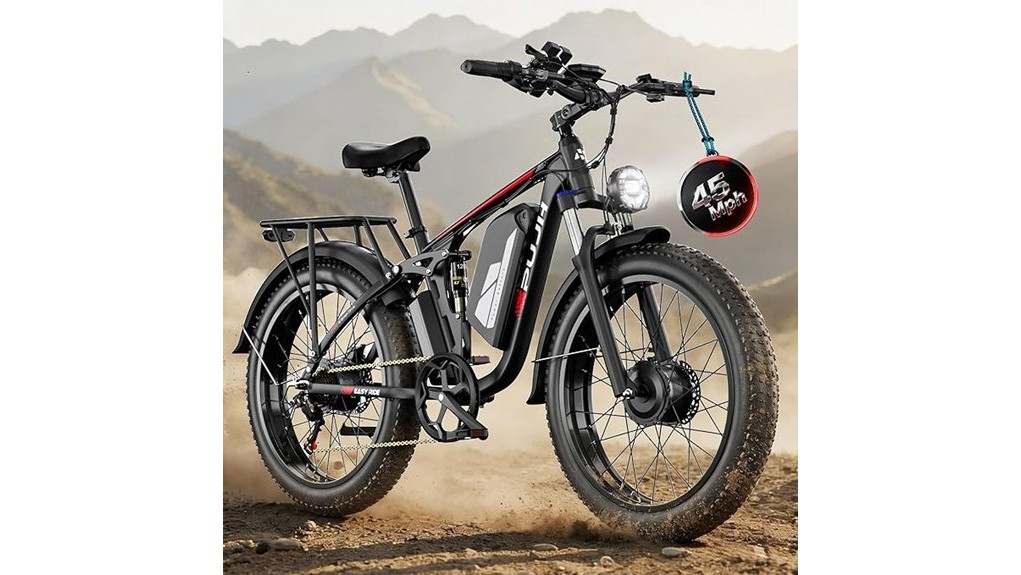

You’re looking at a powerful dual‑motor e‑bike with 6,000W peak and a removable 60V/1,200Wh battery that can hit 45+ MPH on flat pavement. It pairs a 6061 aluminum full‑suspension frame, 24×4.0 fat tires, and dual hydraulic discs for confident off‑road and urban performance. Real ranges vary with throttle: 45–60 miles aggressive, 80–100 miles conservative. It’s heavy but torque‑rich and well‑equipped; keep going to see full specs, ride feel, and ownership details.
Some Key Takeaways
- Dual brushless motors deliver up to 6000W peak and reach burst top speeds over 45 MPH on flat pavement with throttle.
- Removable lockable 60V 1200Wh battery supports conservative assist ranges of 80–100 miles and aggressive throttle 45–60 miles.
- Full-suspension 6061 aluminum frame, 24×4.0″ fat tires, and seven-stage tuning balance comfort and off-road flotation.
- Dual hydraulic discs and strong torque (≈200 Nm) provide confident starts, hill launches, and predictable braking under load.
- Trade-offs include heavy chassis, reduced nimbleness from fat wheels, and legal/safety responsibilities when riding 45+ MPH.
What the 6000W Dual-Motor Bike Actually Includes (Specs & Features)
Explore the core package and components that come with the 6000W dual-motor electric bike: it pairs dual brushless motors delivering a combined peak of 6000W and about 200 Nm of torque with a removable, lockable 60V lithium-ion battery rated at 1200Wh (claimed 100–110 mile range) and a listed off-bike charge time of roughly five hours. You get a 6061 aluminum frame, 24″×4.0″ fat tires, full suspension with seven-stage tuning, 7-speed drivetrain, dual hydraulic discs, and integrated lighting. The removable battery emphasizes battery security; included rack, fenders, and USB port enhance accessory compatibility and practicality. Keep your ebike battery healthy for outdoor adventures by following proper charging, storage, and maintenance practices to maximize lifespan and safety, including battery maintenance best practices.
Performance in the Real World: Speed, Range, and Torque Results
While lab specs promise blistering performance, real-world testing shows how that 6000W dual-motor system and 1200Wh battery translate to usable speed, range, and torque under load. You’ll see bursts to the 45+ MPH claimed top speed on flat pavement with dual-motor throttle, but sustained high-speed runs drop range noticeably. Real world testing across mixed terrain averaged 45–60 miles per charge at aggressive throttle, 80–100 miles with conservative assist. Torque measurement under load confirmed peak-like delivery—strong initial thrust near 200 Nm felt in hill launches and payloaded starts, with predictable tapering at sustained high speeds. For riders who prioritize long outings, upgrading to an extended-range battery pack can significantly increase usable mileage per charge extended range batteries.
Ride, Handling, and Comfort: Suspension, Brakes, and Fat‑Tire Behavior
When you hit varied terrain the PUJH’s suspension and fat‑tire combo work together to smooth impacts and keep traction, delivering a confidence‑inspiring ride without feeling floaty. You’ll notice calibrated suspension tuning across the 7‑level system: fork and rear shock absorb square edges while seat springs add comfort. 24×4.0 fat tires provide pronounced tire flotation on sand and snow, lowering sink and maintaining roll. Dual hydraulic discs give strong brake modulation for predictable stops under torque. Trail feedback remains surprisingly clear for a heavy rig, letting you pick lines with authority while staying comfortable over long, mixed surfaces. These traits pair especially well with fat eBike tires designed for outdoor riders who tackle sand, snow, and rough trails.
Practical Ownership: Battery, Charging, Assembly, Accessories, and Warranty
The PUJH’s composed ride quality is only part of ownership; you’ll also be managing a high-capacity powertrain, routine setup, and a stocked accessory kit that affect day-to-day use and long-term value. You get a removable 60V 1200Wh lithium-ion pack that charges off-bike in about five hours; expect regulated charging and occasional balance cycles to maximize life. Assembly is ~90% complete — torque key tasks, adjust handlebars, and verify brake alignment. Included accessories and US-based support streamline maintenance. Warranty covers core systems for one year; check battery recycling options and read customer experiences for real-world longevity notes. For riders who enjoy outdoor adventures, choosing the right replacement battery can improve range and reliability, especially when considering replacement ebike batteries.
Who Should Buy This Bike : Use Cases, Limits, and Final Recommendation
Because it pairs high-power dual motors, long-range battery capacity, and full-suspension durability, this PUJH dual-motor e-bike suits riders who need serious off-road performance and extended practical range without sacrificing daily-commute usability. You should buy it if you’re an urban commuter who wants rapid highway-capable acceleration, need cargo or heavier rider capacity, or plan long distance touring on mixed terrain. Limits: heavyweight chassis and 24″ fat wheels reduce nimbleness in tight city traffic, battery weight affects handling, and legality/safety at 45+ MPH is your responsibility. Final recommendation: buy if you prioritize power and range over lightweight agility. For riders who enjoy outdoor activities, matching the motor to your intended terrain and use case is critical for getting the best performance from your e-bike motor choice.
Some Questions Answered
Is This Bike Street-Legal in My State or Country?
Probably not — you’ll likely need to check local laws because license requirements and speed limits vary. This 6000W, 45+ MPH capable bike exceeds most e-bike class thresholds, so you’ll probably require registration, a motorcycle endorsement, insurance, and DOT-compliant lighting/plate to ride legally on public roads. Contact your DMV or transport authority, confirm classification and helmet rules, and verify specific equipment and speed limits for permitted use in your jurisdiction.
Can the Battery Be Taken on Airplanes?
No — you probably can’t take that 1200Wh battery on an airplane. Airline restrictions typically limit lithium-ion batteries to 100Wh (carry-on) or 100–160Wh with airline approval; 1200Wh far exceeds limits. You’ll need detailed battery documentation, manufacturer specs, and airline approval for any exception, but most carriers and regulators will refuse. Contact the airline and provide battery documentation; consider shipping via approved cargo services or removing battery before transport.
How Loud Are the Motors Under Full Throttle?
You’ll hear noticeable motor noise and feel throttle vibration under full throttle, but it’s not deafening. The dual brushless motors produce a strong mechanical whine and some high-frequency whirr at peak power; chassis resonance transmits low-frequency vibration through the grips and seat. You’ll detect increased acoustic level near the battery/motor housings and occasional gear/chain noise from the 7-speed drivetrain when under heavy load.
Are Replacement Tires and Tubes Readily Available?
Yes — replacement tires and tubes are readily available. You’ll find tire compatibility with standard 24″ × 4.0″ fat-bike tires, so sourcing options include bike shops, online retailers, and specialty fat-tire suppliers. You’ll want robust 24×4 tubes or tubeless-ready kits for the PU3’s heavy load and high torque. Be sure to match valve type, rim width, and puncture-resistant construction when ordering to maintain performance and safety.
Can the Bike Tow a Small Trailer or Cargo Trailer?
Yes — you can tow a small cargo trailer, but you’ll need to manage cargo hauling limits and tongue weight carefully. The bike’s 330 lb max payload includes rider+cargo; tongue weight should remain modest to avoid overloading the rear wheel, suspension, and rack. Use a sturdy hitch rated for the bike’s weight, distribute load low and forward, and test handling at low speeds. Expect reduced range and braking performance.