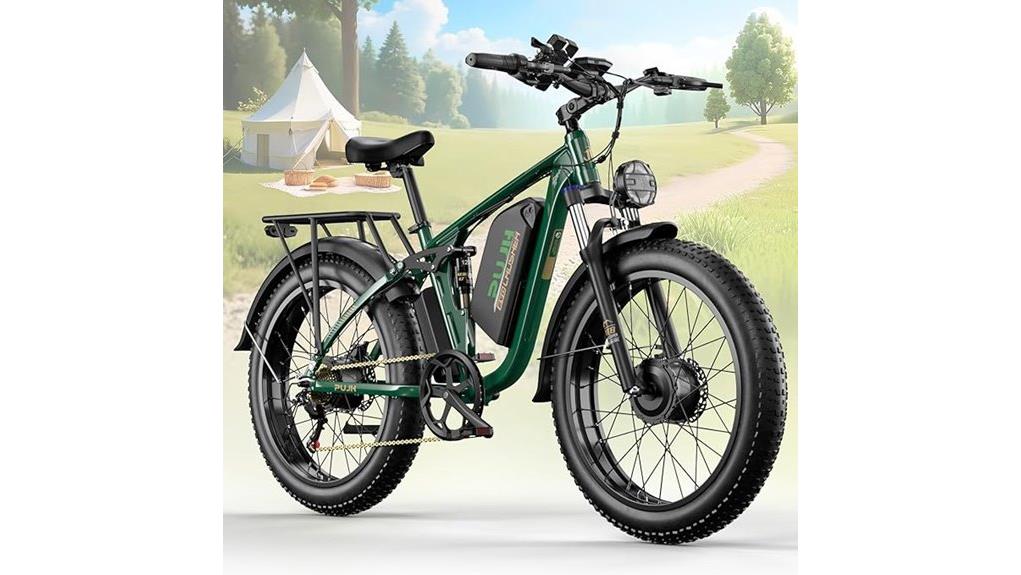
You want raw, off‑road power and this 6000W dual‑motor e‑bike gives it: blistering acceleration, about 400 Nm theoretical torque, and confident hill‑climb and loose‑surface traction thanks to dual hubs, fat tires, and full suspension. It’s heavy (~85 lb), noisy, and legally tricky in many areas, so it isn’t ideal for stealthy commutes or casual riders. Expect wide range swings depending on throttle use and heat stress on components—keep going to see detailed performance, range, and ownership trade‑offs.
Some Key Takeaways
- Dual 6000W (peak) hub motors deliver extreme acceleration, hill-climbing ability, and torque for off-road and heavy-load scenarios.
- Expect top speeds near 45 mph, but real-world speed varies with rider weight, terrain, and local legal limits.
- Range spans roughly 35–110 miles depending on throttle use, riding mode, and battery capacity (example: 60V 20Ah).
- At about 85 lb curb weight, full suspension and 26x4.0" fat tires provide stability but reduce portability and stealth.
- Strong hydraulic brakes and robust frame handle the power, but heat management, warranty, and weight limits require careful attention.
Quick Verdict: Who the 6000W Dual‑Motor Bike Is For and the Headline Pros/Cons
If you want a high‑power, off‑road capable e‑bike that can tackle steep climbs, loose surfaces and carry heavy loads, this 6000W dual‑motor model is built for you; it’s best suited to experienced riders who prioritize speed, torque and rugged versatility over lightweight portability. You’ll like its raw capability: dual hubs, heavy frame, full suspension, and cargo readiness appeal to adventure seekers and specialty rider demographics. Caveats: at ~85 lbs and Class 3 designation, urban legality varies and you’ll face restrictions in many cities. Pros: unmatched traction and load capacity. Cons: weight, regulatory limits, and limited stealth for commuting. Riders should pair this bike with essential trail gear like protective clothing, helmet, and maintenance tools to fully enjoy off‑road outings and stay safe on demanding trails with mountain e‑bike essentials.
Real-World Performance: Speed, Torque, Motors, and Hill‑Climbing Capability
Because the PU3 pairs two brushless hub motors for a combined peak of 6000W and roughly 400 Nm of theoretical torque, you’ll feel aggressive acceleration and confident hill-climbing that few single‑motor e-bikes can match. You’ll hit about 45 mph in ideal conditions; dual-motor Full Throttle for hills gives immediate, sustained thrust. Pay attention to motor durability and thermal management—hard, sustained climbs stress components and heat buildup can limit output. The system’s simple torque vectoring and traction control help translate power cleanly to loose surfaces, but you should still modulate throttle to protect drivetrain and extend component life. This setup is ideal for riders who want reliable off-road performance and adventure riding gear recommendations.
Battery, Range, and Charging : What to Expect in Each Riding Mode
The PU3’s prodigious motor output changes how you should think about the battery: heavy throttle and sustained dual-motor climbs chew through capacity far faster than casual pedaling, so expect wide swings in range depending on mode. With a 60V 20Ah pack (≈1.2 kWh) you’ll see roughly 35–110 miles: full dual‑motor bursts and Full Throttle modes yield the low end, eco modes and steady pedal assist push you toward the high end. Practice charging etiquette, store the removable battery locked and cool, and follow battery safety rules. For freedom, focus on range optimization—plan routes, use eco modes, and charge strategically. For longer outdoor rides, consider carrying a lightweight spare or using battery care best practices to preserve capacity.
Ride Comfort, Build Quality, Brakes, Suspension, and Fat‑Tire Handling
While you’ll notice the PU3’s heft immediately, its suspension and fat tires work together to tame rough terrain and long rides without feeling floaty or disconnected. You get confident tire grip from 26x4.0" rubber that bites sand, snow, and gravel; steering stays predictable. The 7-level shock setup and shock-absorbing saddle plus seatpost travel smooth impacts—seat comfort is good for long hauls, though firm for performance. Dual hydraulic brakes deliver progressive, strong stopping power under load, matching the bike’s speed and mass. Build quality feels rugged: 6061 aluminum frame and solid fittings inspire trust, but expect some weight trade-offs. Riders who prioritize off-road traction will appreciate the PU3’s fat eBike tires for outdoor riding.
Ownership Essentials: Weight Limits, Accessories, Warranty, and Final Buying Checklist
If you plan to use the PU3 for commuting, hauling, or off‑road adventure, pay close attention to its 330 lb maximum weight recommendation and the bike’s roughly 85 lb curb weight—exceeding the limit or adding heavy cargo can strain the motors, battery, suspension, and brakes. You’ll want to confirm accessory compatibility with the solid cargo rack and included kit—phone mount, pump, lock, and tools work, but heavy aftermarket racks or panniers may push you over limits. Check warranty coverage (one year limited on frame, motor, battery, display). Final checklist: weight limits, secure mounting, service plan, and ride test. Also consider choosing racks and accessories designed for ebikes with reinforced mounting to ensure safe hauling.
Some Questions Answered
Will This Bike Fit in My Car Trunk or SUV Cargo Area?
Probably not without work: the bike’s large 6061 frame, 26" wheels and 85 lb weight mean it won’t fit most trunks unless you fold to a compact folding size and remove the seat, battery and front wheel. You’ll need space in an SUV cargo area or fold down seats. Plan for two people to lift, use the lockable removable battery for lighter handling, and measure your cargo dimensions before trying to load it.
Can I Tow a Small Trailer With the Rear Rack Installed?
Yes — you can tow a small trailer using the rear rack, but you’ll want to check cargo capacity and consider rack reinforcement. The rack’s solid design and the bike’s high payload suggest it’ll handle light loads, but heavier trailers stress mounts, braking, and handling. Reinforce attachment points, stay within weight limits, use safety chains and brake-assist gearing, and test gradually so you keep freedom without compromising control or warranty.
Is the Bike Legal to Ride on Bike Paths in My State/City?
Probably not universally — you’ll need to check local regulations and path classifications. Many places ban Class 3 or high-powered e-bikes from multiuse trails or bike paths, and a dual-motor, 6000W machine often exceeds allowed power/speed limits. Contact your city or state DOT, review trail rules, and look for posted signs. If you want freedom, be ready to ride roads or quieter routes where high-power e-bikes are permitted.
Are Replacement Batteries or Upgraded Cells Available Separately?
Yes — you can buy replacement batteries and pursue upgraded cells, but you’ll need to confirm battery compatibility with the PU3’s 60V pack and lock/removable design. Check with the manufacturer or reputable cell sourcing vendors for 18650/21700 options and proper BMS matching. You’ll want verified capacity, discharge rates, and warranty; improper swaps risk performance loss, voided warranty, or safety hazards, so be critical and choose trusted suppliers.
How Noisy Are the Hub Motors During Prolonged High-Speed Use?
The hub motors are moderately loud at prolonged high-speed use; you’ll hear steady whine, audible vibration through frame and handlebars, and occasional gear whir. Expect noise to increase with load and thermal drift as motors heat—power output and tone will shift. You’ll feel the bike’s vigor, but if you crave quiet freedom you’ll want additional damping, tighter mounts, or swapping to quieter hubs to tame resonance and steady-state noise.