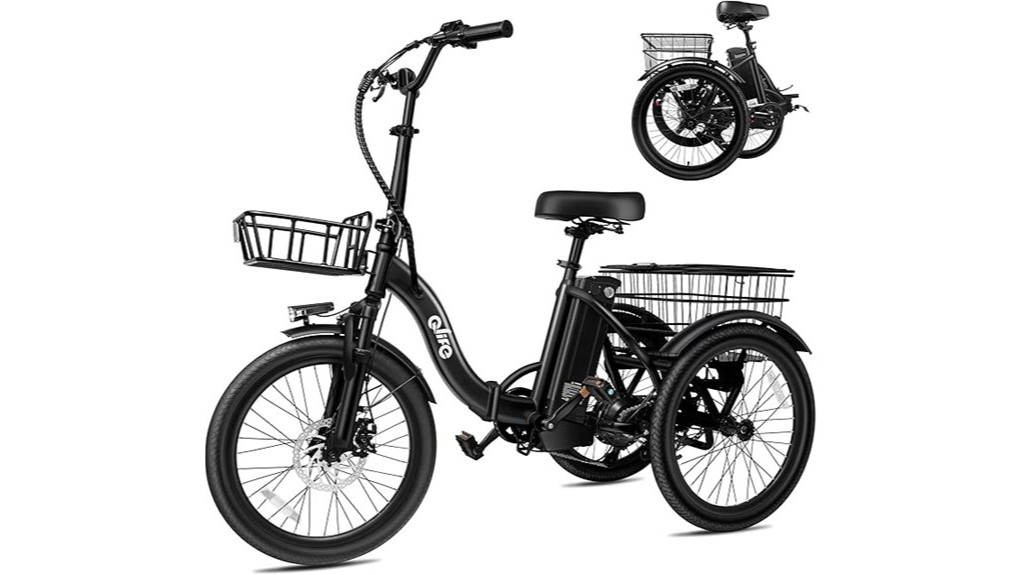

You’ll find the Qlife Triker is a compact, stable electric trike designed for practical urban duty rather than high‑speed or aggressive trail riding. It uses a 750W continuous (1,200W peak) motor with brisk hill acceleration, a removable 499Wh battery yielding roughly 25–45 miles in mixed use, and a step‑thru folding frame with rear differential for steady tracking. It trades sprinting and top speed for balance, cargo utility, and easy storage—keep going to see full specs and checks.
Some Key Takeaways
- Stable, compact step‑thru electric trike ideal for commuting, errands, and riders needing low‑step access and balance.
- 750W continuous (1,200W peak) motor with 18 MPH top speed, offering brisk acceleration for hills and stop‑start urban use.
- Removable 499Wh battery claims up to 55 miles; expect real‑world ranges of about 25–45 miles depending on load and assist level.
- 20″ wheels, rear differential, and disc brakes provide predictable handling, reduced lateral jolt, and consistent wet‑weather stopping.
- Folds compactly with an integrated cargo rack, three ride modes, and adjustable fit—inspect hinges, battery health, and warranty before buying.
Quick Verdict: Who the Qlife Triker Is Best For
While it won’t outpace full-size e-bikes on long mountain climbs, the Qlife Triker suits riders who want a stable, compact electric trike for commuting, errands, and light off-road use. You’ll find it ideal if you’re a commuter seniors seeking low-step access and balance, or a cargo haulers-oriented rider needing integrated rack capacity. Compared with two-wheel e-bikes, it trades top-end speed and hill sprinting for stability, predictable handling, and the benefits of threewheel electric bikes in terms of folding convenience. Disc brakes and a rear differential enhance control; 20-inch tires balance comfort and maneuverability. It’s purpose-built for practical urban duty rather than aggressive trail performance. It also pairs well with cargo-oriented accessories for riders who want to Carry More on outdoor trips.
Powertrain and Range Breakdown: Motor, Battery, and Real‑World Miles
Having established who the Triker suits, let’s examine what actually moves it: a 750W continuous (1,200W peak) brushless motor paired with a 499Wh removable battery. You’ll get brisk acceleration and an 18 MPH top speed; compared with similarly rated motors, torque favors hill climbs and stop‑start urban use. Range claims up to 55 miles depend on assist level, payload, and terrain. Monitor battery health to preserve capacity—partial charges and storage at 40–60% help. Drivetrain efficiency is solid; power delivery is direct with minimal losses. Expect real‑world range closer to 25–45 miles under mixed conditions. This setup is ideal for riders who want to Boost Your Off-Road Thrills with high-performance ebike motors in varied outdoor settings.
Ride Comfort and Stability: Frame, Tires, Differential, and Braking
Because the Triker combines a step-thru folding frame, 20‑inch tires, a rear differential, and disc brakes, you get a ride that prioritizes predictable handling and rider accessibility without sacrificing stability. You’ll notice the low step-thru improves mounting and center-of-gravity control compared with high‑standover frames. The 20‑inch tires balance compliance and cornering precision versus larger wheels. A rear differential reduces lateral jolt on uneven surfaces, enhancing tracking more than a rigid single‑wheel layout. Disc brakes deliver consistent stopping power in wet conditions. Fit options like an adjustable stem and a wide saddle let you tune comfort and control for varied riders. Fat tire ebike riders often prefer models with off-road capability for better traction and versatility.
Practical Features for Daily Use: Folding, Cargo Rack, and Modes
Fold and stow the Triker quickly for multi-modal commutes: its step-thru folding frame collapses compactly for trunk storage or tight apartment spaces, letting you compare it directly with other folding e-bikes regarding packed footprint and ease of handling. You’ll appreciate folding convenience when switching between transit and streets. The integrated cargo rack supports routine errands; cargo capacity suits groceries or small deliveries but isn’t designed for heavy commercial loads. Three ride modes—manual, pedal-assist, full electric—let you tailor effort, battery use, and legal compliance for daily commuting. Controls are straightforward, enabling mode shifts without disrupting urban traffic flow. This model is especially appealing to outdoor adventure riders who need a portable ebike that balances off-road capability with urban practicality.
Final Pros, Cons, and Buying Checklist (What to Inspect Before You Buy)
Before you commit, run through a focused checklist so you know exactly what trade-offs you’re accepting with the Qlife Triker. Inspect motor output, confirm 750W continuous/1200W peak performance, and test hill acceleration versus claimed 18 MPH top speed. Verify battery health, removable 499Wh capacity, and achievable range under your load. Check frame hinges, folding tolerance, 20″ tire condition, and rider fit. Assess brakes, differential stability, and ride modes. Evaluate cargo rack strength and securement against cargo theft. Review warranty coverage specifics: duration, components covered, and claim process. Compare alternatives on these measurable points. Consider upgrading to higher-capacity or aftermarket cells to power up longer rides.
Some Questions Answered
Is the Battery Covered by a Warranty and for How Long?
Yes — the battery warranty typically covers defects for one year, with prorated coverage thereafter if issues arise beyond that period. You’ll get explicit transferable terms only on some models, so compare contracts before buying. This setup balances long term reliability concerns against cost and performance expectations. You should verify exact durations and prorated percentages, since manufacturers vary in how they handle replacements and service under battery warranty.
How Long Does a Full Battery Charge Take?
A full battery charge takes about 4–6 hours using the standard charger; fast chargers can reduce that to roughly 2.5–3.5 hours. You’ll compare battery charge time against range and duty cycle to decide charging frequency. Charging options include on-bike charging and removing the 499Wh pack for indoor charging, which adds convenience. Expect slightly longer times as the pack ages; use recommended chargers to maintain battery health and warranty compliance.
Are Replacement Parts and Service Centers Readily Available?
Yes — you’ll generally find spare availability adequate, though it varies regionally. The dealer network is growing but isn’t as extensive as major brands, so turnaround times can be longer. Technically, common parts (batteries, brakes, tires, drive units) are stocked by many dealers; proprietary components may require factory orders. Compare local dealer density before buying: denser networks mean faster service and lower downtime.
What Is the Total Folded Dimensions and Weight for Transport?
The total folded footprint is approximately 36″ x 28″ x 20″, and the transport weight is about 68 lbs including the battery. You’ll notice that footprint is compact for a trike-style folding ebike, yet heavier than single-frame folding bikes. Compared to similar 20″ wheel models, the transport weight reflects the robust motor and cargo-ready rack. You’ll want to account for the removable 499Wh battery to reduce carrying mass during short transfers.
Does It Come With Integrated Lights and Are They CST or LED?
Yes — it includes integrated lighting, using LED indicators for visibility. You’ll get front and rear lights designed as factory-fitted LEDs rather than CST (incandescent) units, so they’re more energy-efficient and brighter per watt. Compared to aftermarket halogen options, these LEDs offer longer life, lower draw on the 499Wh battery, and clearer signalling. You’ll still want dedicated reflectors and confirm local legal requirements for light intensity.