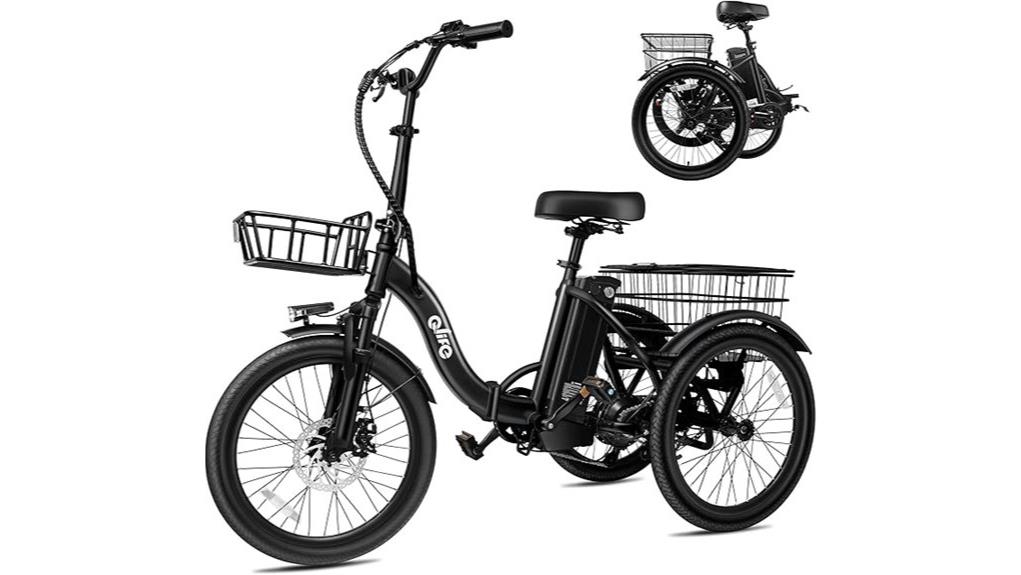
You’ll get a stable, cargo-ready electric trike that’s built for errands, commuting, and heavier riders. Its 750W motor and rear differential give confident starts and smooth cornering, while cadence-assist and a 16 mph top speed keep control predictable. The removable 468 Wh battery can manage roughly 50 miles in mixed use, though weight (about 93 lb) and load affect that. It folds for storage, hauls 400 lb, and if you want specifics, the full review breaks down performance, fit, and trade-offs.
Some Key Takeaways
- Powerful 750W motor with rear differential delivers confident hill-climbing and stable straight-line handling.
- 16 MPH top speed, cadence-sensing pedal-assist, and a full-electric mode for effortless city commutes.
- 468 Wh removable battery claims up to ~50 miles range, affected by wind, load, and assist level.
- Foldable step-through steel frame, three 20″ wheels, and 400 lb payload make it cargo- and senior-friendly.
- Hefty 93 lb weight and assembly needs are trade-offs for cargo capacity and stability.
Quick Verdict: Who the Qlife Triker Is Best For
If you need a stable, cargo-ready electric trike for city streets and light trails, the Qlife Triker fits well: its 750W motor and rear differential give confident hill-climbing and straight-line stability, the 468 Wh removable battery delivers up to about 50 miles per charge, and the built-in cargo rack plus 400 lb payload capacity make it ideal for errands or heavier riders; choose it over a standard e-bike when you prioritize load-carrying, low-speed stability, and easy mounting. You’ll appreciate its foldable step-through frame, three 20″ wheels, and straightforward controls—perfect for commuter seniors and cargo commuters seeking reliable freedom. Explore outdoor adventures with electric trikes designed for ebike riders who enjoy outdoor activities.
Real-World Performance : Motor, Speed, Range, and Hill-Climbing
Having established who the Triker suits, let’s look at what it actually feels like on the road. You get confident thrust from a 750W peak brushless motor—quick off the line, smooth at 16 MPH top speed. Motor efficiency is noticeable: short bursts don’t devour the 468 Wh pack. Cadence sensing pedal-assist keeps power proportional and natural; full-electric mode still feels controlled. Hill-climbing is strong on city grades and light trails, aided by the rear differential and geared drivetrain. Range testing hit up to ~50 miles in mixed assist, though wind, load, and mode selection will change that. Consider pairing it with long-range batteries to extend your adventures and better suit outdoor riders.
Design and Practicality : Frame, Foldability, Wheels, Cargo, and Payload
While compact in profile, the Triker’s step-through carbon steel frame and foldable design make it noticeably more practical for apartment storage and car trunks than traditional trikes. You’ll appreciate the folding mechanism—simple hinges and quick-release clamps—that shrinks length without tools, letting you stash it in tight spaces. Three 20-inch alloy steel wheels balance agility and stability; wheel durability outperforms thinner spoked commuter tires on rough pavement and light trails. A built-in cargo rack handles errands and groceries, and the 400-pound max payload means you can carry people or heavy loads with confidence. At 93 pounds it’s hefty but manageable. It’s designed specifically for ebike riders who enjoy outdoor activities.
Controls, Brakes, Drivetrain, and Ride Stability (Including the Rear Differential)
Beyond storage and cargo, how the Triker actually rides comes down to its controls, braking, and drivetrain setup. You’ll find intuitive ride modes—manual, pedelec, full electric—paired with a geared drivetrain and thumb shifter for straightforward gear changes. Braking uses strong disc calipers with hydraulic levers that deliver predictable modulation and shorter stopping distances compared with cable systems. Electronic shifting would be a modern upgrade, but the current mechanical setup is reliable and serviceable. The rear differential stabilizes three-wheel handling, smoothing cornering and load shifts so you feel confident and free on mixed urban routes and light trails. For riders who enjoy outdoor adventures, consider upgrading to high-quality hydraulic brake pads to maintain optimal stopping power and consistency.
Pros, Cons, Cost Considerations, and Final Buying Recommendation
Because the Qlife Triker balances utility and stability, it makes sense to weigh its clear strengths against practical trade-offs before you buy. You get strong 750W acceleration, cargo capacity, foldability, and stability for confident freedom. Downsides include heft (93 lb), limited top speed, and assembly time. Consider battery maintenance costs and the removable 468 Wh battery lifespan. Factor in warranty limitations when comparing dealers; resale value may hold if cared for and kept stock. Check accessory compatibility for racks, lights, and panniers. Recommendation: buy if you prioritize payload, stability, and practical range over lightweight sport riding. The bike pairs well with specialized ebike cargo rack options to expand hauling versatility.
Some Questions Answered
Does the Battery Support Fast Charging Accessories?
No — it doesn’t officially support fast charging accessories. You can do battery swapping with the removable 468 Wh pack for quick turnaround, but the stock charger follows standard charging specs and lacks advertised fast charging or multiple charging standards. You’ll want to check thermal management if you attempt higher-rate chargers, since stress can shorten pack life. Compared with bikes that list quick-charge support, this setup favors reliability and range over rapid top-ups.
Is There Smartphone App Connectivity or GPS Tracking?
No — you don’t get built-in mobile app or GPS tracking on this model. You’ll rely on the bike’s onboard controls and ride modes instead. Compared to bikes that pair with apps for route, theft alarm, or performance logs, this Triker prioritizes mechanical simplicity and riding freedom. If you want app features or live GPS, you’ll need an aftermarket tracker or a smartphone mount with a navigation app to bridge the gap.
Can the Triker Be Ridden in Heavy Rain or Through Flooded Streets?
You shouldn’t ride it through deep flooded streets; it’s okay in heavy rain if you’re cautious. The Triker has waterproof seals and a drainage design that protect electronics and the removable 468 Wh battery against splashes, but the motor and connectors aren’t rated for submersion. Compared to fully waterproof vehicles, you’ll want to avoid standing water, dry components promptly, and keep rides moderate to preserve range and long-term reliability.
Are Replacement Parts and Service Centers Widely Available?
Not yet widespread — you’ll find limited service centers and spare parts through Qlife and select dealers, but availability lags mainstream brands. Warranty terms cover some defects, yet local repair options vary by region. If you value freedom to ride anywhere, plan for longer wait times for parts or learn basic fixes. Compared to major manufacturers, expect more effort securing components and service, especially in remote areas.
Does the Triker Comply With Local Electric Vehicle Laws and Classifications?
Yes — the triker generally fits e-bike legal classification in many areas: 750W peak and 16 MPH top speed often place it in low-speed electric vehicle or Class 2/3 e-bike categories, but local legal classification and licensing requirements vary. You’ll want to compare your jurisdiction’s power/speed thresholds, helmet and age rules, and whether registration or a license’s required. Check local rules to make certain you stay free to ride without surprises.