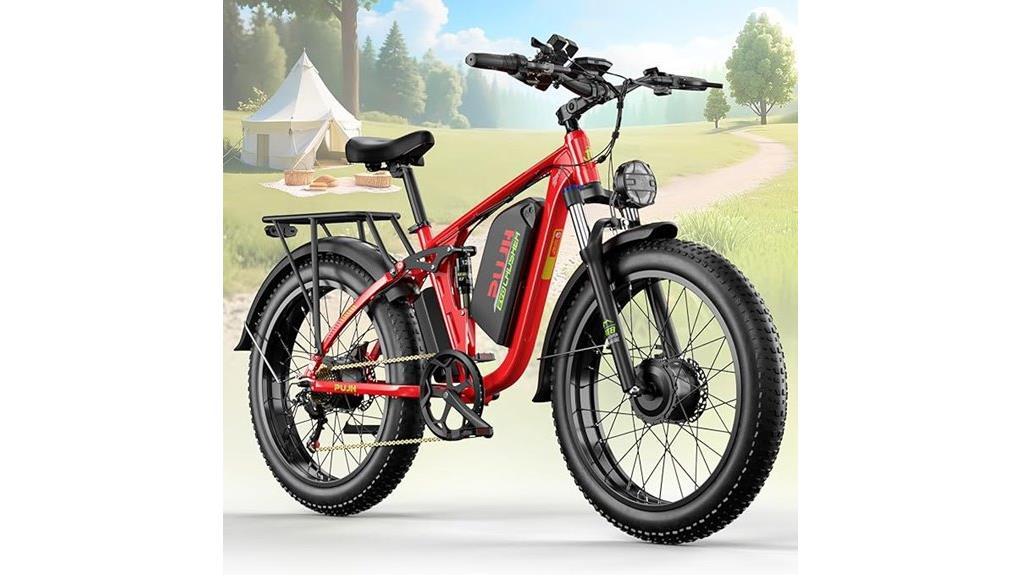
If you want raw speed and off‑road grunt, the PUJH PU3’s dual 6000W setup delivers explosive acceleration and highway‑capable top speeds, with fat tires and full suspension that soak bumps and float on sand or snow. The 60V 20Ah (1,200Wh) battery gives real ranges from about 25–50 miles under aggressive use, more with light assist. It’s heavy and bulky, so plan storage and cautious handling—but keep going and you’ll get a full breakdown of specs, range, and ride feel.
Some Key Takeaways
- Dual 6000W peak motors deliver explosive acceleration and a top speed around 45 MPH on flat ground with a light load.
- 60V 20Ah (1,200 Wh) battery yields 25–50 miles under aggressive dual-motor use, more with conservative pedal assist.
- Heavy 85‑lb frame and fat 26×4.0 tires provide stable off‑road flotation but limit nimble technical trail handling.
- Full suspension is plush; firming settings improve responsiveness for trail riding and high‑speed stability.
- Strong value with bundled accessories and a one‑year warranty, best for riders who prioritize raw power and utility.
What the PUJH PU3 Is and Who It’s For
Think of the PUJH PU3 as a heavy-duty, Class 3 e‑bike built for riders who want serious speed and off‑road capability without hauling a motorcycle. You’ll get raw thrust, robust suspension, and fat tires that let you escape traffic or chase trails. It’s aimed at urban commuters who crave faster, more capable rides and adventure commuters who demand range and ruggedness. You’ll appreciate the removable battery and useful accessories, but expect weight and size compromises for storage and maneuvering. If you want freedom and power in one package and can handle bulk, this fits—if not, consider lighter alternatives. The PU3 pairs especially well with curated top gear for adventure-friendly Class Three e-bike riders to get the most from its capabilities.
Real-World Power, Speed, and Handling: 6000W Dual Motors in Practice
Although the PUJH PU3’s dual 6000W peak motors promise explosive acceleration, you’ll quickly notice how that raw power translates differently depending on mode, terrain, and load. You’ll hit ~45 MPH on flat ground with light load in two-motor mode, but steep climbs or sand slow you. Throttle response is immediate in Full Throttle, giving a liberating surge, yet sustained hard pulls raise motor heat—so manage bursts. Handling stays confident: full suspension and fat tires soak bumps and let you push limits, but weight and torque demand deliberate steering. Ride smart, respect conditions, and you’ll feel freedom without surprises. For riders who take trails seriously, pack the right essential gear to stay safe and comfortable.
Battery, Range, and Charging: How Far Will a 60V 20Ah Pack Actually Go?
You’ve felt how the PU3’s motors chew through terrain and speed; now it’s time to see what that appetite means for the battery. A 60V 20Ah pack (1,200 Wh) delivers claimed 35–110 miles, but real range depends on throttle use, load, terrain, and wind. Expect 25–50 miles under aggressive dual-motor riding; moderate pedal-assist pushes toward the high end. Prioritize battery longevity with partial charges and correct charging etiquette: avoid full 0–100% cycles when you can. High energy density helps weight and range, but temperature effects (cold especially) can cut usable capacity sharply. Plan charging for freedom. For extended trips, carrying a reliable spare battery like those sold for outdoor ebike riders can keep you going without long interruptions, so consider adding a spare battery to your kit.
Ride Comfort, Suspension, and Off‑Road Capability (Sand, Snow, Trails)
Give the PU3 a shove and its suspension soaks up rough ground better than you’d expect from an 85‑lb e‑bike. You feel the 7‑level setup—dual fork shocks, rear shock, seat springs—work together, but suspension tuning matters: leave it stock and it’ll be plush yet vague; firm it up for faster trail lines. Fat 26×4.0 tires add tire flotation on sand and snow, letting you float instead of plow. Dual motors deliver confident traction on loose surfaces, but the heavy frame and weight limit nimbleness on technical singletrack. For freedom seekers, it’s a comfortable, capable cruiser, not a race‑bred trail weapon. It’s especially well-suited to riders who want to conquer trails while enjoying the added stability of fat eBike tires.
Value, Accessories, Warranty, and Final Buy/Skip Recommendation
When you weigh the PU3’s features against its price, it delivers strong value for riders who want power, range, and a long accessories list without paying premium-brand rates. You get cargo rack, fenders, kickstand, tool kit, pump, spare tube, lock, phone holder and shock-absorbing saddle—few rivals bundle this much. Pricing fairness feels solid given 1,200Wh battery and 6000W motors, though build weight and assembly expectations temper enthusiasm. Warranty covers frame, motor, battery, display for one year; customer support is adequate but not stellar. Buy it if you crave raw freedom and utility; skip if you need refined service. The package is especially useful for riders who prioritize ebike cargo rack extensions when carrying gear on outdoor trips.
Some Questions Answered
Can I Legally Register This E-Bike as a Moped or Motorcycle?
Possibly, but it depends on local law: you can’t assume automatic legal classification as a moped or motorcycle. You’ll need to follow your state or country’s registration process, meet horsepower, speed, equipment and insurance requirements, and obtain plates and a title if required. You should check DMV or transport authority rules, submit required documents, and possibly get an inspection. Don’t skip verification — you want lawful, unrestricted riding.
How Long Does the Battery Take to Reach Full Charge?
Around 6–8 hours. With a 60V 20Ah (1,200 Wh) pack and the included charger, you’ll typically full-charge in that window depending on charger output. You should monitor charging safety, avoid overnight charging unattended, and keep the battery cool to extend battery lifespan. If you want faster turnaround, consider a higher-output charger or a second battery, but check manufacturer specs and warranty before changing charging equipment.
Is There a Torque or Power Limit Option for Beginner Riders?
Yes — you can limit power for beginners. You’ll use the assist modes and throttle limiting to tame the 6000W output: choose lower pedal-assist levels or enable single-motor mode, and dial back throttle responsiveness. That reduces torque and top speed so you’ll learn confidently while still enjoying freedom. Be critical about relying solely on limits—practice safe handling and helmet use, and gradually increase power as your skills and comfort grow.
What Replacement Part Lead Times and Shipping Costs Should I Expect?
You’ll typically see shipping estimates of 1–4 weeks for common parts and 4–8+ weeks for rarer components; part availability varies by region and dealer. Expect modest shipping costs for small items ($10–$40) and higher fees or freight for batteries, wheels, or motors ($50–$250+). You should contact the seller for exact timelines, ask about spare-stock policies, and insist on tracking and warranty-covered expedited options to preserve your freedom to ride.
Can I Install Panniers or a Child Seat on the Cargo Rack?
Yes — you can fit panniers and many child seats on the rear rack, but check pannier mounts and child compatibility first. The rack’s cargo focus supports gear, but weight limits (bike’s 330 lb max and rack-specific limits) mean you shouldn’t overload it. Prefer racks with proper mounting points and use a certified child seat rated for e-bikes. Secure attachments, test balance, and keep within manufacturer limits for safe freedom on the road.