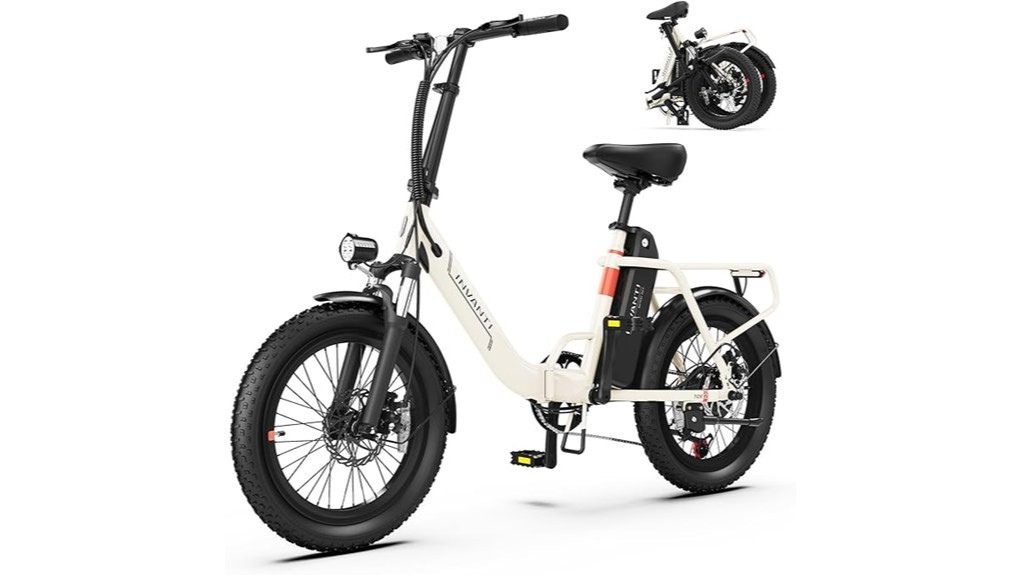

You’ll get a foldable e-bike with a 500W nominal (1,000W peak) motor that punches hard from a stop but saps range under sustained high assist. The 48V 10.4Ah (≈493 Wh) removable battery lets you charge off‑bike, yet high power use drops range to ~25 miles and stresses the system. It’s stable and compliant on fat tires with front/seat suspension, but 60.6 lb steel construction limits portability. Scroll on to see detailed performance, cargo, and maintenance notes.
Some Key Takeaways
- Powerful 500W nominal (1,000W peak) motor gives brisk acceleration and strong hill punch from standstill.
- 48V 10.4Ah (≈493 Wh) removable battery supports ~25 miles at high assist; Eco mode extends range and cell life.
- 20″×3″ fat tires, front suspension, and seat shock deliver stable, compliant ride over varied terrain.
- Steel step‑thru foldable frame weighs 60.6 lb, folds compactly, and supports 110 lb rear‑rack and 330 lb total.
- Tradeoffs include limited pure‑electric range, heavy steel construction, and need for routine brake/drivetrain/battery maintenance.
Quick Verdict and Standout Specs for the INVANTI Tide 2
Although it folds for easier storage, the INVANTI Tide 2 prioritizes power and utility: you get a 500W nominal (1,000W peak) motor, 48V 10.4Ah (≈493 Wh) removable battery, 20″ × 3″ fat tires, and a 7-speed rear derailleur in a 60.6 lb step‑thru package. You’ll value folding convenience for transit and compact storage, but weight still limits true portability. The battery is removable, aiding charging and claiming improved battery longevity if you follow proper charge cycles, yet capacity only supports modest ranges. Controls and components are utilitarian; brakes, suspension, and rack are serviceable but not premium. Expect competent commuting performance, not refinement. Riders who enjoy outdoor activities will appreciate accessories like racks and fat tires for hauling gear and handling varied terrain, especially when planning longer trips with an adult ebike.
How the 1000W Motor and Battery Perform in Real-World Rides
You’ve already seen the Tide 2’s spec sheet, so let’s look at how its 500W nominal (1,000W peak) motor and 48V 10.4Ah (~493 Wh) battery actually behave on the road. You get brisk acceleration from standstill in electric mode; torque delivery is immediate but tapers under sustained climbs, requiring pedal input or lower gearing for long 15% grades. Battery longevity in daily commuting depends on assist level—eco preserves cells and extends cycle life; high power shortens range to ~25 miles and increases thermal stress. Charging is predictable; the pack is removable for off-bike charging and diagnostics. For adventure riders who value power and durability, choosing the right motor setup can make a big difference for off-road performance.
Comfort, Build, and Portability: Folding, Suspension, and Ride Feel
When you fold the INVANTI Tide 2, its compact package and 60.6 lb heft make it clearly portable for short lifts and trunk stowage but still demanding for frequent multi-leg carrying; the step-thru frame and removable 48V battery help with handling and reduce single-lift weight. You’ll notice firm high-carbon steel tubing and precise folding mechanics that lock securely but require two hands and deliberate alignment. Front suspension and seat shock absorb chatter; 20″ fat tires increase compliance. Ride feels stable and planted, not plush—expect controlled damping, firm returns, and credible urban comfort, though long rides expose chassis stiffness. The bike suits outdoor riders who value easy mounting and versatility with step-through ebikes for recreational use.
Practical Use Cases, Cargo Capacity, and Daily Commute Fit
Because the Tide 2 balances a compact fold with a 110 lb rear-rack rating and a 330 lb overall capacity, it suits short urban commutes, grocery runs, and light cargo errands where you’ll rely on the removable 48V battery and sturdy frame for predictable load handling. You’ll use pedal-assist to extend range for commuter cargo and rely on full-throttle bursts for hills or heavier loads. The 20″ fat tires stabilize boxed items; folding saves storage. Be critical about range with loaded trips—493Wh limits pure-electric distance—and secure weight distribution to avoid handling degradation during grocery hauls. Its compatibility with ebike cargo rack extensions makes it easier to carry larger or oddly shaped loads.
Pros, Cons, Buying Tips, and Warranty/Aftercare You Should Know
Though compact and capable, the Tide 2 has trade-offs you’ll want to weigh before buying: it delivers strong hill punch and a useful 110 lb rear-rack capacity, but the 493 Wh battery limits pure-electric range and the 60.6 lb curb weight plus a step-thru steel frame affect portability and long-term corrosion resistance. You’ll appreciate robust motor torque, fat tires, and foldability, but expect heavier handling and limited battery endurance. Buying tips: test-fold, verify fit, and prioritize serviceable components. Check warranty nuances—what’s covered and excluded—and follow a strict maintenance schedule for brakes, drivetrain, and battery to preserve performance. Designed for outdoor riders who value compactness and off-road capability, the Tide 2 aligns with the needs of compact eBikes enthusiasts.
Some Questions Answered
Does the Bike Come With Pre-Installed Lights and Reflectors?
Yes — the bike includes a factory headlight and basic reflectors, but you’ll want a headlight upgrade for serious night rides. You’ll notice reflector placement is minimal: small reflectors on the rear rack and pedals, with no integrated side-wheel reflectors. You’ll need to add brighter front/rear lights and side reflectors for legal compliance or improved visibility. Installation is straightforward and compatible with the integrated rear rack.
Is There Theft Protection or Lock Compatibility?
No integrated alarm system or rim mounted lock is included, and the bike lacks built-in theft protection. You’ll need to fit aftermarket solutions: a rim mounted lock can secure the wheel, and independent alarm system units attach to frame or saddle for motion alerts. Choose hardened U-locks or folding locks for frame-to-fixed-object security, and verify mounting points and battery access so added devices don’t interfere with folding or battery removal.
Can the Battery Be Airline-Checked or Shipped Internationally?
No, you can’t airline-check the battery; its 493.48 Wh exceeds most airline battery restrictions. You’ll face battery restrictions and shipping limits for air travel and many carriers. To ship internationally you’ll need compliance with dangerous-goods regulations, special packaging, carrier approval, and possible disassembly or battery removal. Contact carriers and check local import rules; you’ll likely send the bike without the battery or use specialized freight services under strict shipping limits.
Are Replacement Batteries and Parts Readily Available?
Yes — you’ll find limited battery availability and parts sourcing through Invanti’s channels and select dealers, but third-party options are sparse. You’ll want to order the 48V 10.4Ah removable battery and common wear items (tires, brake pads, derailleur parts) directly from the manufacturer or specialized e-bike suppliers. Expect lead times and compatibility checks; verify connectors, voltage, and warranty coverage before purchasing to avoid mismatched components.
Is There Smartphone App or Bluetooth Integration?
No — there’s no dedicated app integration advertised, and Bluetooth pairing isn’t specified. You’ll rely on the bike’s built-in digital display and controls for metrics and settings. That limits telemetry, ride-logging, firmware updates, and remote diagnostics. If mobile connectivity matters, you should confirm with the seller for recent firmware or OEM app plans; otherwise plan to use third-party GPS/logging apps on a separate phone mount.