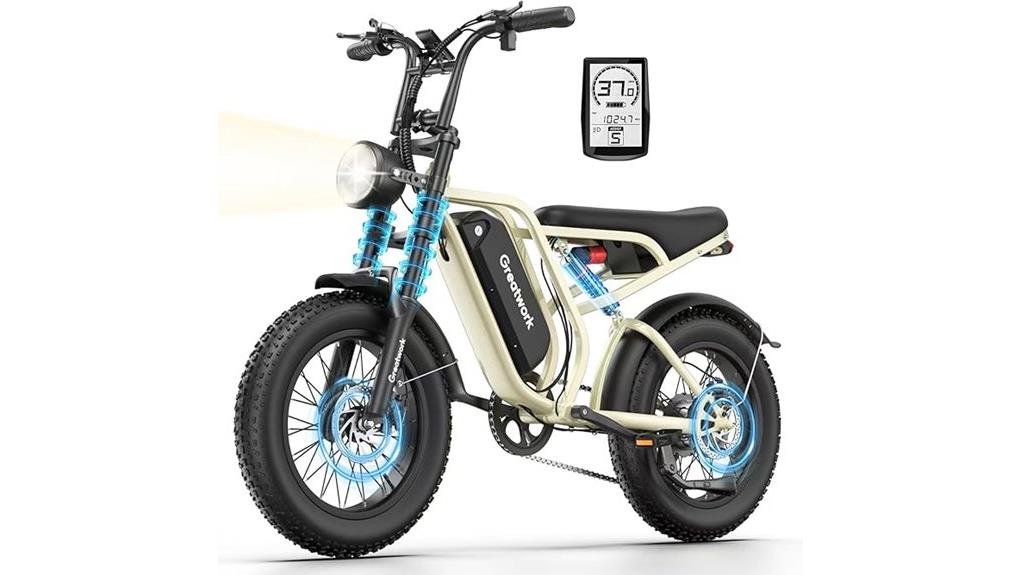
You’ll get a high‑torque, versatile e‑bike driven by a 2000W continuous (2500W peak) motor and 1,200Wh removable battery, so acceleration and sustained climbs feel immediate and controlled. Expect up to ~37 MPH on flats under ideal conditions, hill grades to ~35°, and PAS ranges near 100 miles in conservative use, with throttle range of 40–60 miles. Full suspension, 4″ fat tires, and dual discs give stable handling and braking, and further specifics follow below.
Some Key Takeaways
- Powerful 2500W peak (2000W continuous) motor delivers strong, immediate torque and brisk acceleration for flats and steep climbs.
- Top speed advertised around 37 MPH, with hill‑climb capability rated to 35° under ideal conditions.
- 48V 1,200 Wh removable battery offers ~40–60 miles throttle-only, up to ~100 miles using PAS under ideal conditions.
- Full‑suspension frame, dual front forks, and 4″ fat tires provide stable handling and comfort across mixed terrain.
- Dual disc brakes, 7‑speed drivetrain, and 330 lb payload capacity suit commuting, trail riding, and heavier loads.
Quick Verdict: Who the GREATWORK 2500W Peak Bike Is Best For
If you want a high‑power, versatile e‑bike that handles commuting, off‑road trails, and long rides, the GREATWORK 2500W peak (model R8) is built for riders who need strong torque, range, and load capacity without sacrificing comfort. You’re a commuter or adventure rider who values payload (330 lb limit), robust 2000W continuous motor with 125 N·m torque, and a 1200 Wh removable battery offering up to 100 miles in PAS. Full suspension, 4″ fat tires, dual disc brakes, and 7-speed derailleur let you switch between urban commuting, trail riding, and long distance touring with confidence and operational clarity. We also offer accessories and upgrades designed for extended range to help you push farther on every ride.
Real-World Performance: Speed, Hill Climb, Torque, and Handling
When you push the GREATWORK R8, its 2000W continuous (2500W peak) motor delivers immediate, high‑torque acceleration—125 N·m translates to brisk launches and confident overtakes up to the advertised 37 MPH on flat ground under ideal conditions. You’ll notice strong hill‑climb capability—rated to 35°—with low motor strain and predictable torque delivery. Acceleration consistency across PAS levels is good, though top speed depends on load and terrain. Full suspension and 4″ fat tires provide cornering stability and planted feel at speed, while dual discs and seven‑speed drivetrain offer controllable modulation for spirited, long‑distance freedom riding. Built for outdoor riders, this high-performance setup complements a range of ebike motors and accessories aimed at enhancing off-road thrills.
Battery, Range, and Charging: What to Expect for PAS vs Pure Electric
Because the R8 pairs a high‑capacity 48V, 25Ah (1,200 Wh) removable battery with a powerful 2,000W continuous/2,500W peak motor, you’ll see markedly different real‑world ranges between Pedal Assist (PAS) and Pure Electric modes: in PAS mode the system supplements your pedaling so energy draw drops substantially, enabling up to about 100 miles under ideal conditions, whereas relying solely on throttle (Pure Electric) typically yields 40–60 miles depending on rider weight, terrain, and assist level. Expect range variance from speed, elevation, and cargo. Charge fully in 7–8 hours; follow Charging safety guidelines to protect battery lifespan and pack integrity. Many riders extend outings further with external range extender batteries designed for e‑bike use.
Build, Suspension, Brakes, and Comfort Features Tested on Mixed Terrain
Although the R8 looks heavy on paper, its carbon‑steel frame and full‑suspension layout work together to keep handling predictable across mixed terrain. You’ll notice frame durability in welded joints and reinforced tubing resisting flex under load; the dual front forks and single rear spring absorber isolate impacts, preserving traction. Dual disc brakes deliver linear, adjustable stopping force for sudden descents. The 7‑speed derailleur pairs with five assistance modes to manage cadence and motor torque. Long faux‑leather saddle and adjustable post focus on seat ergonomics for extended rides, while 4″ fat tires smooth chatter and enhance stability. The bike’s accessories and gear options make it well suited for riders who enjoy outdoor activities and trail riding with an e‑bike essential gear.
Final Buying Considerations: Price, Warranty, Assembly, and Alternatives
If you’re weighing the R8 against other high‑power commuter and off‑road e‑bikes, factor in total ownership cost and serviceability alongside headline specs: the sticker price reflects a 2,000W continuous/2,500W peak motor, 1,200Wh removable battery, and full‑suspension hardware, but you should also account for shipping, potential import duties, replacement battery or brake components, and periodic drivetrain maintenance. You’ll want to use price negotiation on initial purchase, verify the manufacturer service network and 24/7 support, follow assembly tips for the 90% pre‑assembled bike, and evaluate upgrade options (battery, brakes, tires) relative to aftermarket availability. Consider keeping your battery healthy for longer rides by following best practices for storage and care, including battery maintenance.
Some Questions Answered
Does the Battery Lock or Detach for Airline or Train Travel?
Yes — the battery detaches. You’ll remove the 48V, 25Ah (1200 Wh) pack via its mounting and keyed lock for battery removal, letting you carry it separately. Note that airline compliance is restricted: most airlines limit lithium batteries to 100 Wh without approval and 100–300 Wh with airline approval; 1200 Wh exceeds standard allowances, so you’ll need special cargo arrangements and carrier approval before flying. Train rules vary by operator.
Can the Bike Be Fitted With a Child Seat or Rear Rack?
Yes — you can fit a child seat or rear rack, but you’ll need to verify mounting points and load limits. The rear triangle and seatpost area accommodate standard rack mounts; choose a heavy-duty rack rated for the bike’s 330 lb max rider plus cargo and child weight. Use a child seat compatible with fat‑tire frames and full‑suspension bikes, and secure to rack or frame per manufacturer specs to maintain safety and handling.
Are Replacement Batteries or Motors Readily Available?
Yes — replacement batteries and motors are generally obtainable. You can source aftermarket batteries that match the 48V, 25Ah (1200Wh) spec, but check connector type, BMS and IP54 rating. Motor swaps are feasible — many shops handle hub-motor replacements or Motor swaps to equivalent power (2000W cont., 2500W peak) but require compatible controller, mounting and torque arm upgrades. You’ll want technical fitment verification and warranty considerations.
Is the Frame Compatible With Different Wheel Sizes or Tire Swaps?
Yes — you can swap tires within limits. You’ll need to check wheel clearance and axle standards before changing sizes: the frame accepts 20″ wheels with 4″ fat tires; narrower tires fit easily, but larger diameters or widths may rub suspension, fenders, or chainstays. Axle standards are hub-style for the stock wheels, so you’ll need compatible axles or adapters. Measure clearance, confirm dropout spacing and torque specs to preserve safety and handling.
Does the Bike Include Theft-Prevention Features or GPS Tracking?
No — the bike doesn’t include a built‑in alarm system or GPS tracking. You’ll need to add an aftermarket tracker or alarm module and hardwire or mount it to the 48V battery/frame. For security, consider immobilizers and frame anchors; document serial numbers and photos for insurance coverage and claims. Installation requires basic electrical skills and waterproofing considerations (IP54 battery rating), so plan mounting location, wiring routes, and backup power for the tracker.