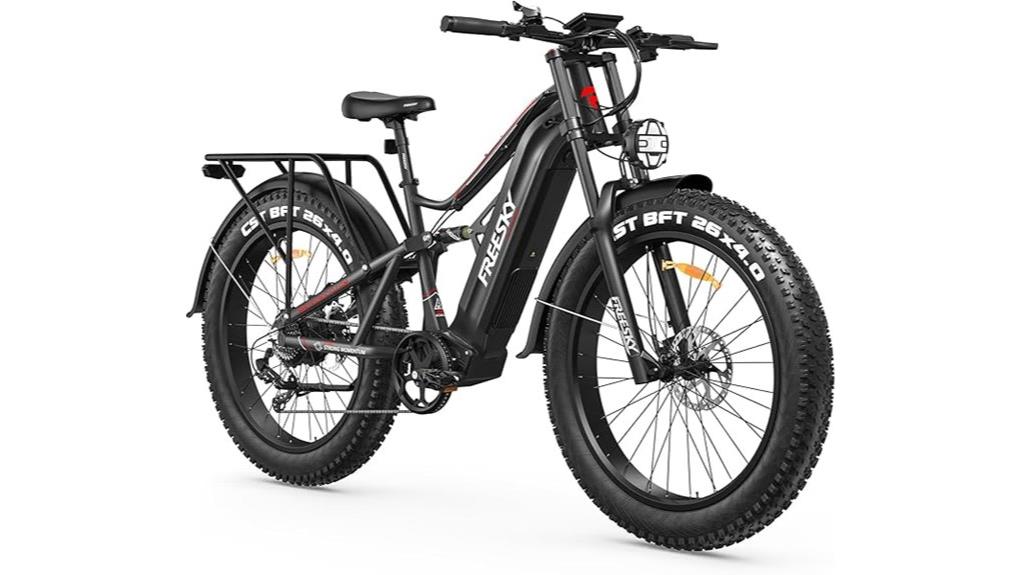
You’ll get a purpose-built, high‑torque e‑cargo bike with a peak 2,500W Bafang motor and 48V 30Ah (1,440 Wh) Samsung battery, designed for steep climbs, heavy loads and long distances rather than light urban agility. It’s UL‑certified, has thermal protection, integrated lights and swipe‑to‑lock security, dual suspension, 26×4 fat tires and a 400 lb payload rating. Expect 75–120 miles PAS range with conservative use and some thermal throttling under prolonged heavy loads — more specs and caveats follow.
Some Key Takeaways
- Powerful 2,500W peak Bafang motor (140 Nm) excels at steep climbs and heavy cargo hauling.
- Large 48V 30Ah (1,440 Wh) Samsung battery delivers approximately 75–120 miles PAS range, depending on load and terrain.
- Robust safety: UL 2849 system and UL 2271 battery certifications, thermal protection, and integrated lighting.
- Stable, comfortable ride with dual suspension, 26×4 fat tires, 4‑piston hydraulic brakes, and 400 lb payload rating.
- Ownership needs include routine maintenance, potential thermal throttling under sustained load, and a 24‑month core warranty.
Quick Verdict: Who the FREESKY 2500W Bafang Bike Is Best For
While the FREESKY 2500W Bafang excels as a high‑torque, long‑range e‑MTB, it’s best suited for riders who need heavy-duty hill‑climbing and cargo capability. You’ll appreciate its 140 Nm motor torque, 1,440 Wh battery, and 26×4 fat tires when you haul loads or tackle steep terrain. Commuter suitability is conditional: it’s overbuilt for light urban hops but valuable if your route includes steep grades or you carry substantial gear. Certification (UL 2849, UL 2271) and integrated lights improve safety and legality. If you crave freedom to carry and conquer, this bike delivers rugged capability. The review site also covers choosing the right ebike motor for adventure and related top gear topics.
Real-World Performance and Range: Motor, Speed Modes, and Battery Expectations
Because the FREESKY pairs a peak 2,500W Bafang motor (140 Nm) with a 48V 30Ah (1,440 Wh) Samsung battery, you can expect strong hill‑climbing and sustained high‑power performance, but real‑world range will vary widely with mode, rider weight, and terrain. In practice you'll see 75–120 miles per charge under PAS for a 75 kg rider; throttle use, heavy cargo, or steep terrain reduce that. Monitor battery longevity via charge cycles and onboard real world diagnostics to track capacity fade. Watch for thermal throttling during prolonged high‑load climbs. Plan routes accounting for terrain effects and conservative range margins. Consider upgrading to a long‑range battery to extend your ebike adventures.
Safety, Certifications, and Built-In Lighting/Security Features
Although you’ll want to verify local regulations before riding at top speeds, the FREESKY X-6E’s electrical system and battery carry TÜV SÜD UL certifications (UL 2849 for the system, UL 2271 for the Samsung-cell pack), and the bike integrates multiple safety and security measures—overheat protection for the motor, swipe-to-lock with key card/password, and integrated lighting with turn signals, brake lights, and an 800‑lumen headlight—to help maintain safe operation and theft deterrence. You’ll benefit from LED signaling for visibility, robust Security systems with access control, sine-wave controller stability, and a clear 24-month motor/battery warranty that supports confident, liberated riding. The bike is compatible with a range of reliable ebike charger adapters suitable for outdoor riders who need dependable charging options.
Ride Comfort and Handling: Frame, Suspension, Brakes, Tires, and Payload
Having covered the bike’s safety, certifications, and integrated lighting/security, let’s look at how the X-6E handles on the trail. You get a 6061 aluminum L-frame with conservative frame geometry that balances stability and nimbleness for fast descents and long rides. Dual suspension—double-crown fork and rear shock—absorbs chatter, claiming a 70% comfort increase. Dual 4-piston hydraulic discs deliver predictable stopping power under load. CST 26×4 fat tires offer strong tire grip on loose surfaces and float on sand. Rated for 400 lbs, the chassis and components support heavy payloads without compromising control or freedom. Riders should consider essential gear for mountain-ebike riders like helmets, gloves, and repair kits for safer, more enjoyable trail outings.
Ownership Costs, Warranty, Maintenance Tips, and Final Buying Checklist
When you factor in upfront price, expected service intervals, and warranty coverage, the X-6E's true cost of ownership becomes clear: FREESKY backs the core electrical components (motor, battery, controller) and frame for 24 months and other parts for 12 months, while the UL-certified battery and system reduce risk of early failure, but you should still budget for routine wear items (brake pads, tires, drivetrain) and occasional suspension or electrical diagnostics. Plan a maintenance schedule: inspections every 500–1,000 miles, annual brake and drivetrain service. Estimate Annual costs for consumables and diagnostics, keep common replacement parts on hand, and confirm warranty terms before purchase. Also consider storing and charging the battery following best practices to extend its usable life.
Some Questions Answered
Can I Legally Ride This Bike on Local Bike Paths and Trails?
Maybe — you’ll need to check local regulations and trail classifications first. Many bike paths restrict motors over certain wattages or top speeds and prohibit throttle-only operation; class-based systems may limit you to Class 1 or 2 e-bikes. Carry specs (2500W peak, 38 mph PAS release, 20 mph throttle) and certification documents to argue compliance. Obtain local authority guidance or permits if needed, and respect posted signage and shared-use rules.
How Long Does the Removable Battery Take to Fully Charge?
You can fully charge the removable 48V 30Ah battery in about 6–8 hours with the included charger. You’ll use standard Type-C connectivity for convenience; fast charging isn’t specified, so expect full cycles to follow that 6–8 hour window. Charging behavior and lifespan depend on charge cycles and usage patterns — follow recommended charging practices to maximize usable cycles and preserve battery health for long-range freedom.
Is There Smartphone App Connectivity or GPS Tracking Available?
Yes — you can connect via a mobile app and use an integrated gps tracker. The bike’s HD display and sine-wave controller support app pairing for ride data, mode control, and firmware updates; the gps tracker provides location and basic anti-theft functions. You’ll get remote diagnostics, trip logs, and geofencing options. That setup keeps you free to roam while maintaining technical control, remote security, and concise maintenance awareness.
What Accessories (Racks, Fenders, Mirrors) Are Compatible Out of Box?
You can fit standard rear rack mounts and install aftermarket mud guards using the bike’s integrated eyelets and quick-release wheel design. Mirrors with bar-end or clamp mounts are compatible with the flat handlebar; confirm clamp diameter. Cargo racks rated for heavy loads (up to 400 lbs system limit) attach to seatstay and dropout mounts. Use manufacturer quick-connect plugs for accessory wiring. You’ll want threaded fender hardware and torque-specified fasteners for secure, durable installation.
How Easy Is Transporting the Bike on a Car Rack or in Storage?
You can transport it reasonably easily with planning: the non-folding frame means it’s bulky, but good weight distribution and quick release wheels let you lower profile on most hitch or pickup racks. Handlebar removal and disconnecting the hidden battery reduce width and weight for tight storage. Use the 85% pre-assembly setup to re-secure components quickly. Expect a heavy lift—use two people or a lift-assist strap for safe loading.