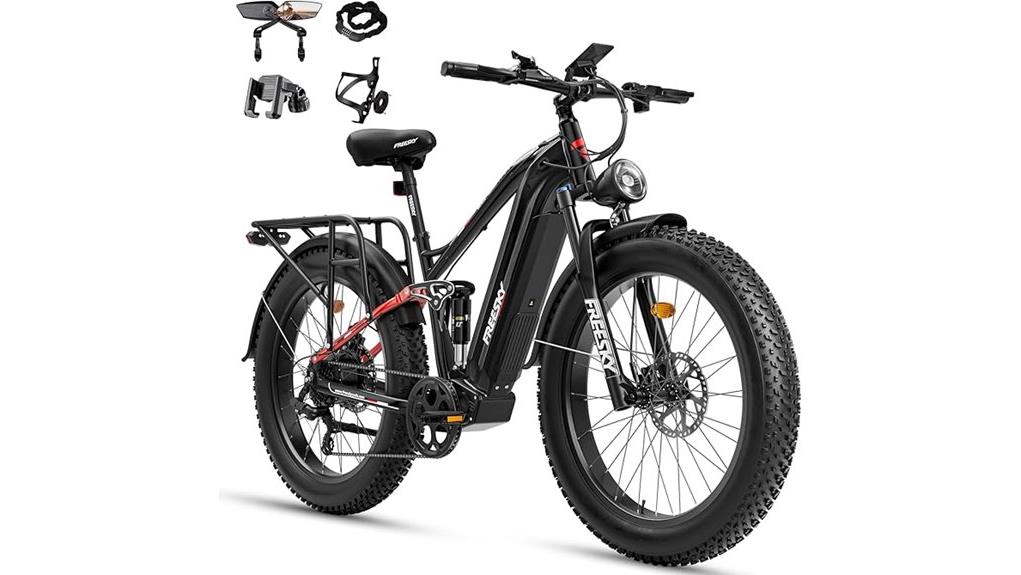
You'll get motorcycle-like acceleration from the FREESKY 2000W—strong peak torque and confident climbs—paired with a hidden 48V 25Ah battery giving roughly 50–95 miles depending on assist, rider, and terrain. It’s heavy (78 lb) with a long wheelbase, so it’s stable at speed but not nimble on tight trails. Four-piston brakes, full suspension, fat tires, and lights make it commuter- and cargo-ready, though kids or technical riders may prefer lighter options; keep going for full specs and tradeoffs.
Some Key Takeaways
- Powerful rear-hub motor: 2000W peak (1,000W nominal) with 130 N·m torque delivers strong acceleration and steep-climb capability.
- Long-range battery: hidden removable 48V 25Ah (1,104 Wh) offers roughly 50–95 miles depending on assist, terrain, and load.
- Solid stopping and control: four-piston hydraulic brakes with dual 180mm rotors plus full suspension and 26×4.0" fat tires for stable handling.
- Heavy but stable ride: 78 lb and longer wheelbase reduce agility but improve high-speed cornering and load carrying.
- Practical features: UL2271 battery, IP65 enclosure, 800-lumen headlight, turn-signal taillight, and seven-speed drivetrain for versatile use.
FREESKY 2000W At a Glance: Key Specs and What They Mean
While the FREESKY 2000W packs big numbers, you should focus on the specs that affect daily riding: a rear-hub brushless motor rated peak 2000W (nominal 1000W) with 130 N·m torque promises strong acceleration and climbs up to 40°. You’ll get a 48V 25Ah hidden battery (1,104 Wh) with IP65 waterproofing and UL2271 certification, removable for charging. The bike balances power with a 7-speed derailleur, full suspension, 4-piston hydraulic discs, and 26×4.0" tires for varied terrain. Expect 50–95 miles per charge depending on load and conditions; charging takes 5–7 hours. Designed for outdoor riders who value easy mounting and dismounting, the FREESKY is well-suited to step-through ebikes and adventure-ready use.
How It Rides: Motor Power, Climbing, Speed, and Handling on Real Roads
The specs above set expectations, but how the FREESKY feels on real roads comes down to how its motor, torque, gearing, and chassis work together. You get strong, immediate torque delivery from the 2000W peak rear hub, so climbs up to steep gradients feel confident with pedal assist; throttle is capped lower. The seven-speed drivetrain smooths cadence shifts and keeps the motor in its sweet spot. At speed the full suspension and fat tires absorb rough surfaces while four-piston brakes provide decisive control. Cornering stability is impressive for a 78 lb bike, though weight and wheelbase limit quick flickability. For riders who enjoy outdoor adventures, choosing the right ebike motor and components can make a big difference in off-road performance and reliability, especially when comparing ebike motor types and their suitability for rough terrain.
Battery, Range, and Charging : Real-World Numbers and Factors That Change Them
Because the FREESKY packs a 48V, 25Ah (1,104 Wh) removable battery with UL2271 certification and IP65 protection, you can expect substantial range but should plan for wide real-world variance. You’ll see 50–95 miles depending on assist level, rider weight, terrain, and wind. Charger is 54.6V 3A; full charge takes about 5–7 hours. Monitor efficiency via the display and adapt habits to extend range. Over years battery degradation and temperature effects will lower capacity, so store and charge properly. If you value freedom, treat range estimates as guidance, not promises, and plan backups. For replacement batteries and accessories suited to outdoor riders, consider options designed for outdoor rides and the demands they place on battery performance.
Comfort, Suspension, Brakes, and Safety Features Tested
Range and battery behavior matter because they change how you'll feel on longer rides, but comfort and stopping power shape every mile you actually ride. You sit on a supportive saddle; seat comfort is good for long hauls but firm for sportier control. Suspension tuning balances compliance and pedaling efficiency — lockable fork and rear shock let you choose plush or planted. Brake feel from four-piston hydraulics and dual 180mm rotors is progressive, powerful, predictable. Safety tech (800-lumen headlight, turn-signal taillight, horn, reflectors) enhances visibility. Together these systems let you ride farther, faster, and with confidence. Choosing the right brake pads for e-bike use can improve modulation and longevity, especially when riding off-road with higher loads and speeds, so consider e-bike brake pads matched to your riding style and rotor size.
Who Should Buy It : Use Cases, Limits, and Value Compared to Alternatives
If you need a heavy-duty, high-speed e-bike that handles steep climbs and long rides, the FREESKY 2000W is aimed at commuters and sport riders who want motorcycle-like performance with pedal options. You’ll find strong commuter suitability for fast, longer urban runs and heavy loads, plus excellent hill climbing. It’s less ideal if you want pure trail agility—offroad limits appear on tight singletrack and technical rock. Family friendliness is moderate: sturdy and roomy but heavy for casual users or kids. Compared to cheaper commuters or light fat-bikes, its price value favors riders needing power, range, and payload capacity. It also pairs well with top gear for adventure-friendly Class Three e-bike riders like cargo racks and outdoor accessories.
Some Questions Answered
Can I Legally Ride This Bike on Bike Paths in My State?
Maybe — it depends on state laws and local path classifications. You should check your state laws for e-bike classes and whether throttle or 37 MPH capability disqualify it from multi-use bike paths. Many paths limit motor power, top speed, or allow only Class 1/2 e-bikes (pedal assist, restricted speed). You’ll want to verify signage, municipality rules, and carry proof of specs in case an official questions your bike.
How Heavy Is the Removable Battery for Carrying Upstairs?
The removable battery weighs about 28–30 pounds, so you'll notice its heft when carrying it upstairs. For stair portability, use a sturdy grip and lift with your legs, or carry it with two people for safer handling. Its IP65 casing and handle aid transport, but plan breaks and a clear path. If you want lighter portability, consider a wheeled carrier or leaving the battery secured at the base to avoid frequent heavy lifts.
Are Replacement Parts Readily Available Locally?
Yes — you’ll generally find replacement parts through local dealers and online, though availability varies. You can get common items (tires, brakes, batteries, drivetrain) from local dealers or compatible aftermarket suppliers; aftermarket compatibility is strong for standard components, less so for proprietary electronics/controller parts. You’ll want to confirm part numbers and warranty terms before buying, and consider dealer support for installation to preserve performance and your riding freedom.
Can the Speed Limiter Be Safely and Legally Removed?
You can physically remove the speed limiter, but doing so carries legal risks, warranty voiding, safety implications, and electronics tampering concerns. If you unseal the controller you’ll gain higher speed, yet you may violate local laws, nullify warranties, and increase crash risk from reduced braking margin and altered handling. Weigh your desire for freedom against potential fines, invalidated support, and the need for professional, compliant modifications to stay safer and legal.
Is There a Theft Recovery or GPS Tracking Option Compatible?
Yes — you can add GPS trackers and insurance options. You’ll install aftermarket GPS trackers (hidden or OBD-style) for real-time location, geofencing, and recovery; choose units with long battery life or wired power. Pair tracking with thorough bike insurance or specialized e-bike policies that cover theft and recovery fees. Compare providers for claims limits, deductibles, and recovery assistance so you’ll maximize freedom while minimizing replacement risk.