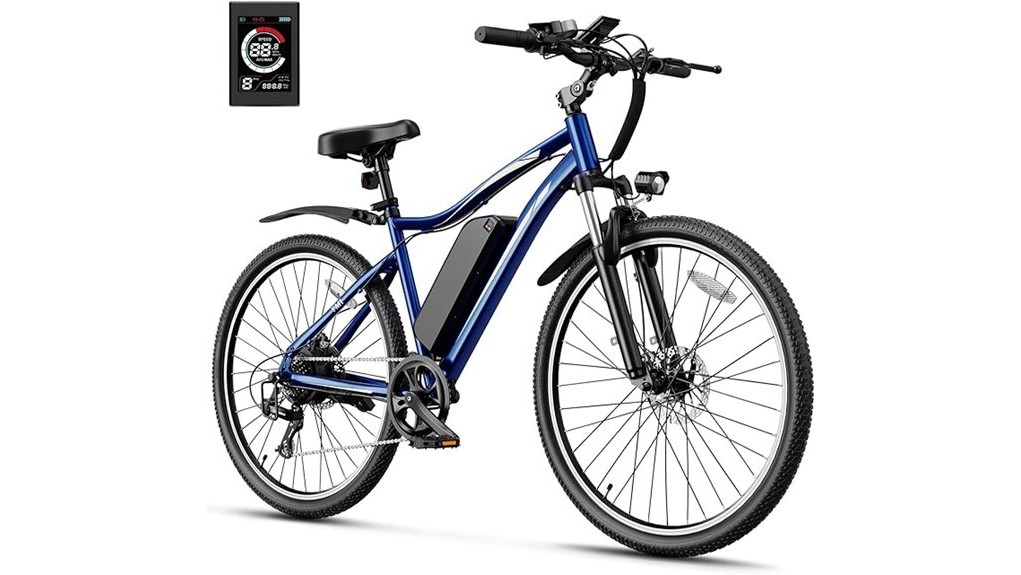

You’ll get a comfortable, commuter-focused e‑MTB that favors punchy low‑end power and long range over race‑grade handling. It uses a 750W brushless motor with a 48V/10Ah removable battery, hits 22–28 mph on flats, and usually manages ~35–40 miles in mixed use. Suspension and puncture‑resistant tires smooth city and light‑trail rides, while dual discs stop reliably. It’s heavier and not for aggressive trail racing, but if you want more detail you can keep exploring the full review.
Some Key Takeaways
- Solid 750W brushless motor delivers strong low-end torque, reaching sustained speeds around 22–28 mph on flats.
- 48V/10Ah removable battery yields real-world range about 35–40 miles on mixed-assist rides.
- Comfortable ride with front suspension, 27.5″ puncture-resistant tires, and stable handling for commuting.
- Dual disc brakes and practical lights/fenders provide reliable everyday safety and utility.
- Heavier build and limited warranty make it better for dependable commuting than racing or extreme trails.
Heybike YM1 at a Glance: Specs, Pricing Signals, and Who It’s For
While it won’t match high-end eMTBs, the Heybike YM1 delivers a strong value proposition: a 750W brushless motor (peaking advertised higher), 48V/10Ah removable battery giving roughly 31–50 miles per charge, 27.5″ puncture-resistant tires, front suspension and dual disc brakes—features you’d expect from a mid‑range electric mountain bike. You’ll get practical urban commuting performance, solid hill assist, and a sturdy aluminum frame that tolerates light cargo compatibility with racks or panniers. Price signals favor budget-conscious riders who want power without premium cost. It’s best if you prioritize utility over cutting-edge components or race-grade handling. This model is well suited for riders who enjoy outdoor activities and need reliable accessories for longer rides, including cargo racks and panniers.
Real-World Ride Test: Speed, Range, Handling, and Comfort Results
Because you’ll be comparing claimed specs to real conditions, the YM1’s on-road performance is best judged across mixed urban, light trail, and hill routes to see where it shines and where it falls short. You’ll find top speed near advertised on flats with throttle, though sustained 22–28 mph depends on weight and wind. Range in my loop sat around 35–40 miles with mixed assist—short of top-end claims under aggressive riding. Handling is stable; cornering feedback is predictable but soft suspension blunts sharp inputs. Uphill performance is respectable for a mid-weight rider, though steep grades slow cadence without lower gearing. This test also noted the convenience of carrying a compact ebike pump for quick outdoor repairs.
Powertrain Deep Dive: Motor, Battery, Modes, Gearing, and Charging Details
If you’re focused on how the YM1 delivers propulsive power, its 750W continuous brushless motor (marketed as 1200W peak) and 48V/10Ah removable battery form a competent mid‑mount powertrain that balances punch with range. You’ll find motor tuning favors strong low‑end torque for climbs while top speed caps near legal limits; throttle and PAS modes feel distinct. The 7‑speed derailleur pairs well with PAS levels 1–3 and full‑electric throttle for flexible cadence choices. Charging finishes in about 5–6 hours with fast‑charge support; pragmatic owners will appreciate battery longevity features like overcharge protection. For riders who enjoy outdoor activities, Top Gear’s advice on choosing the right ebike motor can help match motor characteristics to your adventure needs.
Safety and Durability Check: Brakes, Suspension, Tires, Lights, and Build Quality
Although the YM1’s components lean toward commuter-grade rather than race‑spec, you’ll find a solid safety and durability package that suits everyday riding: dual disc brakes offer reliable stopping power, a high‑strength front suspension fork smooths rough trails, and 27.5‑inch puncture‑resistant tires balance traction with longevity. You’ll notice decent brake modulation for predictable stops, though high-speed riders may want stronger calipers. The aluminum triangular frame resists frame fatigue in typical use, but heavy off-road abuse could expose limits. Light placement is practical—bright LED headlight and rear reflector—while fenders and sturdy build add practical longevity and confidence. For riders focused on maintenance and performance, choosing the right ebike brake pads can further improve stopping power and pad longevity.
Buying Considerations: Assembly, Warranty, Pros vs Cons, and Final Recommendation
When you’re weighing the Heybike YM1, think about how assembly, warranty, and tradeoffs affect real-world ownership: the bike ships about 90% assembled so you’ll need only basic tools and a short setup (videos and a manual guide the process), the 12‑month warranty and responsive support cover typical faults but not wear items, and the overall package favors reliable commuter use—comfortable suspension, puncture‑resistant tires, and strong brakes—over race‑grade performance, meaning you’ll get good daily value unless you demand high‑speed handling or heavy off‑road abuse. You’ll appreciate easy final assembly, low tool maintenance, and clear return policy terms. Pros: value, comfort, range. Cons: weight, not top‑speed focused, limited warranty span. Recommendation: buy if you want a dependable eMTB for commuting; skip it if you need racing or extreme trail specs. Riders who enjoy outdoor adventures may also want to consult our Essential Ebike Guides for tips on gear and maintenance.
Some Questions Answered
Does the YM1 Fit Riders Over 6’4 Comfortably?
Not really — riders over 6’4 will likely find the YM1 tight. You’ll benefit from the adjustable stem and seat, but frame sizing and handlebar reach are aimed at large but not extra-tall riders. Compared to long‑reach frames, the YM1 feels more compact; you’ll get less leg extension and strain on your back unless you modify stem length or swap a longer handlebar. Test fit or choose a larger‑frame e‑MTB.
Can I Ride the YM1 in Heavy Rain or Through Streams?
You shouldn’t ride the YM1 through deep water or heavy rain without caution. The bike has some waterproofing limits and a drainage design for occasional splashes, so light rain and shallow puddles are usually fine. Compared to fully waterproof e-bikes, its components (battery, motor, display) aren’t sealed for submersion, so avoid streams and prolonged wet exposure. Dry and inspect electrical connections after wet rides to prevent damage.
Are Replacement Batteries or Keys Readily Available?
Yes — you’ll generally find battery availability and key replacements accessible through Heybike and major e-bike part retailers. Compared to boutique brands, Heybike’s 48V, 10Ah removable battery is commonly stocked, though stock can vary by region. Key replacements (for the removable battery lock) are easier if you register or keep a key code; otherwise locksmiths or Heybike support can help. Prices and shipping times beat many niche makers.
Is the Bike Compatible With Child Seats or Cargo Racks?
Yes — you can fit a child seat or cargo rack, but with caveats. The Heybike YM1’s aluminum triangular frame and adjustable stem support rear racks and many child-seat mounts, yet its battery placement and weight limits mean you’ll need a sturdy, rack-compatible model and possibly a low-profile rear rack. Compared to full cargo e-bikes, it’s less ideal for heavy loads; confirm rack specs, payload limits, and installer recommendations before buying.
What Smartphone Apps, if Any, Connect to the YM1?
No dedicated companion app is officially listed for the YM1, so you won’t find full-featured app controls; Bluetooth pairing typically supports basic readouts on generic e-bike apps or aftermarket displays. Compared to rivals with polished apps, the YM1’s connectivity is limited: you can pair for simple diagnostics or speed/odometer logging, but don’t expect route planning, firmware updates, or deep customization without third-party workarounds or hardware mods.