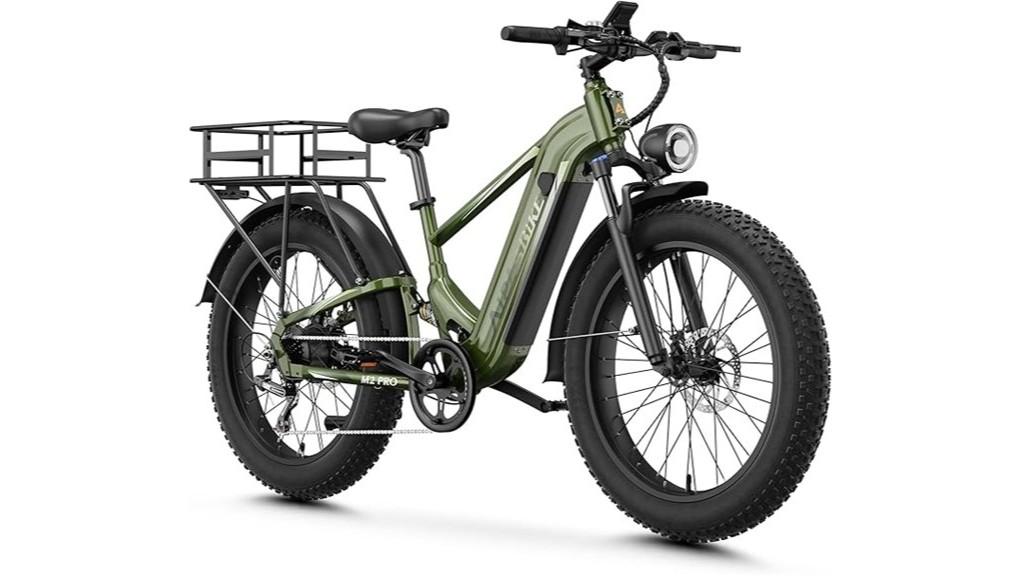

You get brutal 1,800W peak thrust and 110 Nm torque from a rear hub motor, backed by a removable 48V 17.5Ah (832Wh) battery that yields 36–85 miles depending on assist and terrain. Fat 26×4.0″ tires and dual lockable suspension deliver traction and comfort but add weight and rolling resistance. Controls are clear, braking is robust, and the chassis suits steep climbs and utility use. Keep going and you’ll find detailed performance, handling, and fit notes.
Some Key Takeaways
- 1,800W rear hub motor with 110 Nm torque delivers immediate, sustained hill-climbing power and strong technical-section thrust.
- Removable 48V 17.5Ah (832Wh) battery yields real-world range of about 36–85 miles depending on assist level and terrain.
- Fat 26″ x 4.0″ tires and dual suspension provide confident traction and chatter-damping but add weight and rolling resistance.
- Controls include a clear digital display, USB charging, five ride modes, and a 7-speed twist shifter for predictable shifting under load.
- Best for riders needing high-torque off-road commuting and trail capability; cons include heaviness, limited small frame, and one-year warranty.
Quick Specs and What Makes the M2 Pro Stand Out
The M2 Pro packs robust eMTB hardware into a compact aluminum frame: a 1,800W peak brushless rear hub motor delivering up to 110 Nm of torque, a removable 48V 17.5Ah (832 Wh) battery, and fat 26″ x 4.0″ tires for traction. You get dual suspension, 7-speed gearing, 180mm dual disc brakes, integrated lights and a digital display with USB. It excels as a hill-capable, high-speed commuter and trail rig. Maintain battery care—store cool, charge regularly—and fit essential offroad accessories like skid plates and reinforced racks. Assembly’s minimal; warranty and lifetime tech guidance support ownership. For more on choosing the right motor for adventurous riders, consider ebike motor selection when matching power and terrain.
How the 1800W Motor, 110 Nm Torque, and Battery Perform in Real Rides
When you open the throttle or push into pedal assist, the M2 Pro’s 1,800W peak motor and 110 Nm of torque deliver immediate, sustained thrust that catapults you up grades and through technical trail sections without hesitation. You’ll notice crisp torque delivery across the cadence band; hill starts and steep pitches feel controlled rather than sudden. The 48V 17.5Ah (832Wh) battery supports aggressive riding—real-world range varies 36–85 miles depending on assist level and terrain—but battery longevity seems solid with proper charging habits. Thermal management held up on extended climbs; expect consistent power output until charge depletion, then predictable tapering. This model is aimed at riders who want to boost their off-road thrills with high-performance ebike motors and components off-road thrills.
Ride Comfort and Handling : Frame, Fat Tires, and Suspension Tested
Because you’ll be tackling varied terrain, the M2 Pro’s aluminum eMTB frame, 26″ x 4.0″ fat tires, and dual lockable suspension work together to prioritize stability and rider confidence. You’ll notice the low-slung frame geometry lowers center of gravity, improving straight-line tracking and climb stability. Fat tires soak chatter and increase traction; they blunt sharp impacts but add rolling resistance. Lockable, adjustable fork lets you tune compliance versus efficiency for climbs or descents. Seat ergonomics are adequate for medium rides but padding and position could be refined for long days. Cornering feedback is predictable though heavy; expect deliberate lean and confident grip. This setup is ideal for off-road riding across varied outdoor trails.
Controls, Range, and Daily Usability (Display, Modes, Gearing, Lights)
Although the display and control layout look simple, you’ll find them functionally robust: a clear digital readout with USB charging and integrated buttons gives immediate access to five riding modes (Electric, Pedal Assist, Cruise, Normal, Walk Booster) while the 7-speed twist shifter and responsive motor deliver predictable power shifts across speeds. You’ll appreciate display ergonomics—buttons are tactile, legible in motion, and USB practicality lets you top up devices. Mode customization is basic but effective; shift responsiveness is sharp under load. For daily commuting the lighting effectiveness and included horn boost security features, and maintenance access is straightforward for routine checks. Many riders enhance trips by pairing smartphone-integrated displays for navigation and performance tracking with their ebike setups smartphone display.
Who Should Buy the M2 Pro : Pros, Cons, and Value for Money
Who is the M2 Pro really for? You want high-torque, off-road-capable transport: the 1800W motor, 110 Nm torque, fat tires, and dual suspension suit trail riders, steep climbs, and utility runs. If commuter suitability matters, it handles mixed urban routes and wet conditions but size and top speed may exceed local regulations. Pros: strong hill climbing, long range (36–85 mi), removable 832Wh battery, robust braking, and solid cargo capacity potential with aftermarket racks. Cons: heavy, limited frame size (small), assembly needed, one-year warranty. Value: high if you need power and versatility; less so for minimalists. Riders should also pack essential gear for mountain e-bike trails, including hydration, repair tools, and protective equipment like helmets and pads for safe riding on rough terrain, reflecting typical needs for mountain e-bike riders.
Some Questions Answered
Is the Battery Removable for Air Travel or Checked Luggage?
Yes — the battery is removable, but you’ll need to follow airline restrictions. The 48V 17.5Ah (832Wh) pack exceeds most airlines’ carry-on limits (usually 100–160Wh), so you can’t take it on flights without special airline approval and documentation. You’ll evaluate options: ship the battery separately via approved hazardous-goods carriers, obtain airline approval for checked/checked acceptance, or remove battery and arrange compliant transport to avoid regulatory violations and safety risks.
How Long Does the Battery Take to Fully Charge From Empty?
You’ll fully charge the removable 48V 17.5Ah (832Wh) battery in about 6–8 hours with the stock charger; fast chargers may cut that to roughly 3–4 hours. Charging time impacts battery lifespan: frequent fast charging or deep discharges will reduce cycle life, so you should balance charge speed and longevity. For best lifespan, avoid constant rapid charges, keep state of charge between ~20–90%, and store partially charged if idle.
Can the Motor and Display Firmware Be Updated by the User?
Yes — you can perform firmware updates and access user accessible diagnostics, but options are limited. You’ll use the bike’s display interface and any manufacturer app or USB port if provided; Aipas may require dealer-level tools for advanced flashing. You can view basic diagnostic readouts, error codes, and update prompts, yet full ECU tuning or deep firmware changes typically need authorized service to avoid warranty voiding. Verify with support first.
What Is the Bike’s Total Weight and Maximum Rider Capacity?
The bike’s total weight is roughly 75–85 lbs, and the rider capacity is rated around 330 lbs. You’ll handle a heavy, robust build that’s typical for 1800W fat‑tire eMTBs; the weight affects maneuverability and transport, while the 330 lb capacity guarantees strong load tolerance for most riders plus gear. If you need higher payload or lighter transport, consider aftermarket luggage solutions or a lighter-frame alternative.
Are Replacement Parts and Accessories Readily Available Locally?
Yes — you’ll generally find replacement parts and aftermarket accessories available locally. Check local dealers for common items like tires, tubes, brake pads, batteries, and display modules; they often stock wear items and compatible components. For model-specific parts (battery packs, proprietary controllers), you’ll rely on manufacturer channels or online suppliers. Expect quicker service for standard components and longer lead times or special ordering for proprietary items. Verify compatibility before purchase.