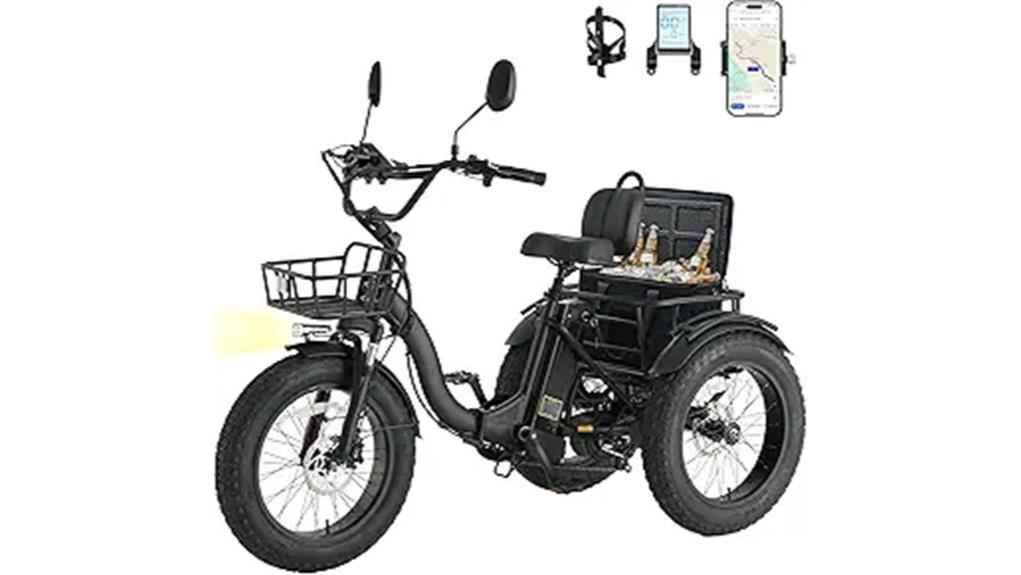

You’ll find the Skeri electric tricycle favors stability and cargo over outright speed, using a 750W (1,350W peak) rear-hub motor that typically hits about 20 MPH unloaded and climbs moderate grades at reduced pace. Its low step-through frame, 20″x4″ fat tires and rear differential prioritize predictable handling and load confidence, while hydraulic discs and a parking brake give controlled stopping. The removable 48V 13Ah battery yields practical range under varied conditions, and more specifics follow below.
Some Key Takeaways
- Stable, low-center-of-gravity design prioritizes cargo capacity and confidence over high-speed agility.
- 750W (1,350W peak) rear-hub motor delivers about 20 MPH on flat ground under light load.
- 48V 13Ah (624 Wh) removable battery yields up to ~50 miles PAS in ideal conditions; real-world range varies.
- 20″×4″ fat tires, rear differential, and hydraulic brakes provide predictable cornering and strong stopping power.
- Ample cargo (front/rear baskets, rear rack), 24-month warranty, and 90% pre-assembled delivery for practical urban use.
Quick Verdict and Who This Trike Is Best For
While the Skeri electric tricycle prioritizes stability and cargo capacity, it also delivers solid mid-range performance with its 750W (1,350W peak) hub motor and fat 20″×4″ tires, making it a pragmatic choice for riders who need reliable utility rather than high-speed sport. You’ll find it optimized for urban commuting and senior mobility: low center of gravity, step-through frame, and hydraulic brakes favor control and confidence. Compared to two-wheel e-bikes, it trades agility for load capacity and steadiness. If you want freedom to carry groceries or commute without balancing concerns, this trike fits that mission. It’s a good option for outdoor enthusiasts who want an electric trike tailored to cargo and stability for ebike riders.
Real-World Power and Ride Performance (Motor, Speed, Hill Climbing)
Expect the Skeri’s 750W (1,350W peak) rear-hub motor to deliver steady, mid-range thrust rather than explosive acceleration: in flat urban conditions you’ll reach the listed 20 MPH top speed under light load, but actual top speed falls with heavier cargo, headwinds, or steeper grades. You’ll notice competent motor torque for starts and sustained climbs; manufacturer rates capability on ~20% inclines, though speed will reduce. The rear-hub differential aids cornering stability without compromising power delivery. Compared with similar 750W trikes, ride efficiency is competitive thanks to a 7-speed drivetrain and efficient power transfer, extending usable range. The trike’s design and motor choice make it well-suited for outdoor activities commonly enjoyed by ebike riders who value stability and cargo capacity.
Comfort, Stability, and Braking on Varied Terrain
Because the Skeri combines a low center of gravity, 20″ x 4″ fat tires, and a rear-hub differential, you’ll get noticeably greater stability and compliant ride quality across mixed surfaces compared with typical three-wheelers that use narrower tires or rigid rear axles. You’ll notice predictable cornering as the differential reduces scrub while the fat tires absorb irregularities. Hydraulic disc brakes deliver linear stopping force, and the hydraulic parking brake secures the trike on slopes. Adjustable seat ergonomics and deliberate suspension tuning (tire pressure plus frame compliance) let you trade firmness for comfort, preserving control whether you cruise boardwalks or gravel paths. For active ebike riders who value dependable stopping power and durability, choosing the right disc brake pads can make a significant difference in real-world braking performance.
Battery Life, Charging, Range Expectations, and Safety Certifications
Having covered how the frame, tires, and brakes affect ride quality, let’s examine how the Skeri’s power pack influences real-world range and charging behavior. You get a removable UL Certified 48V 13Ah (624 Wh) battery that balances mass and energy for practical trips. Expect up to 50 miles in PAS under ideal conditions; real range varies with load, gradient, wind, and riding style. Charging etiquette matters: use the supplied charger, avoid deep discharges, and store partially charged in extremes. Battery certifications reassure safe operation; compared to similar trikes, Skeri’s pack is competitive in energy density and safety. This product is designed for riders who enjoy outdoor adventures and supports ebike battery care best practices to keep the battery healthy for longer.
Cargo, Folding/Assembly, Warranty, and Final Buying Recommendations
While the Skeri’s cargo layout combines versatility and stability, it stands out for practical errands: dual baskets up front and rear plus a sturdy rear rack give you ample, secure capacity for groceries or gear, and the low center of gravity keeps loads from upsetting handling. You get efficient cargo organization for balanced loads versus competitors. Foldability tests show the aluminum frame collapses compactly with basic assembly tools; 90% pre-assembled reduces setup time. Warranty claims are handled under a 24-month policy with 24/7 support, matching industry norms. Final recommendation: choose this trike if you value stable load-carrying freedom. The trike pairs well with purpose-built rear racks and accessories for enhanced utility and safety, like those recommended for ebike riders who enjoy outdoor activities and cargo organization.
Some Questions Answered
Can This Trike Fit Inside a Standard Car Trunk When Folded?
Probably not in most sedans: the foldable trike’s folded dimensions and bulk (folding aluminum/carbon-steel frame, 20″ wheels, fat tires, baskets) make trunk compatibility limited. You’ll compare hatchbacks, SUVs, and vans favorably — they’ll accept the folded trike more readily. Measure your trunk against the trike’s folded dimensions and factor tire width and rear rack. If trunk compatibility’s critical, choose a roomy hatch or use roof/receiver transport for true freedom.
Is the Battery Removable for Air Travel or Tsa-Compliant Transport?
Yes — the battery is removable, and that helps with air compliance. You can detach the UL‑certified 48V 13Ah (624 Wh) pack for transport, which compares favorably to non‑removable systems that block travel options. Note airlines and TSA have watt‑hour limits and require approval for batteries over 100 Wh; at 624 Wh this pack exceeds those limits and won’t be air‑shippable without special freight arrangements and carrier approval.
Can I Add an Electric Throttle-Only Mode for Assisted Riding?
Yes — you can fit a throttle conversion to enable full-electric, throttle-only riding, but you’ll need to check compatibility with the motor controller and battery connectors. Technically it’s feasible and often simple compared with mid-drive swaps, yet you should weigh legal implications: local e-bike laws may restrict throttle use or power limits. You’ll want a certified kit, controller programming, and to document changes to avoid fines or insurance issues.
Are Replacement Parts and Accessories Readily Available Locally?
Yes — you’ll generally find replacement parts and accessories through local dealers and online channels, though availability varies. Compared to mainstream e-bike brands, OEM components (batteries, hydraulic brakes, drivetrain) may be less abundant, so you’ll rely more on aftermarket accessories and universal parts. You’ll want to contact local dealers for specific stock and warranty-supported items, and order specialty components online to maintain freedom and minimize downtime.
What Is the Maximum Rider Weight and Cargo Capacity Combined?
The combined maximum payload capacity is 330 lbs, covering rider limits plus cargo. You’ll find this payload capacity aligns with many adult electric trikes but is below heavy-duty cargo trikes (often 400–600+ lbs). Technically, that means you should plan rider weight and groceries/tools together under 330 lbs to maintain stability, braking performance, and drivetrain longevity. You’ll retain more freedom if you compare models and select one matching your typical loads.