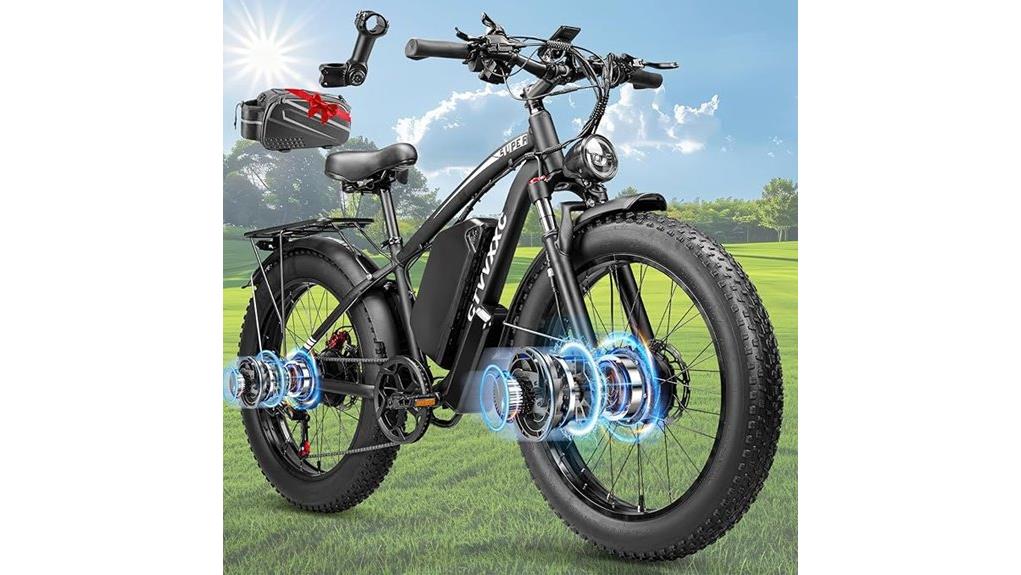

You’ll get blistering acceleration and hill‑climbing from twin 4,500W motors (9,000W peak) that’ll push this 87 lb fat‑tire ebike to a regulated ~45 MPH—so wear protection and verify local laws. The 52V 34Ah battery gives long range on low PAS and about 25–30 miles at top assist, while hydraulic fork, wide 24×4″ tires and dual discs keep handling composed and stopping predictable. It’s performance‑focused; keep going to learn specifics on range, charging, and fit. The 8000w dual motor ebike features advanced technology for an unparalleled riding experience. With its robust drivetrain and high-capacity battery, riders can expect both impressive speed and endurance on long journeys. Additionally, the intuitive control systems enhance maneuverability, making it suitable for a variety of terrains.
Some Key Takeaways
- Two 4,500W brushless motors deliver up to 9,000W peak and strong hill-climbing torque for brisk acceleration.
- Regulated top speed around 45 MPH on PAS Level 5, check local laws before riding at that speed.
- 52V 34Ah (1,768 Wh) battery yields up to ~100 miles on PAS 1 and roughly 25–30 miles on PAS 5.
- Robust aluminum frame, 24×4.0 fat tires, upgraded hydraulic fork, and dual hydraulic discs provide stable, confident handling.
- Heavy 87 lb build and high power suit serious off-road riders; consider lower-power alternatives for legal simplicity and easier storage.
Performance and Power: Real-World Speed, Torque, and Hill Climbing
Fire up both motors and you’ll feel the EB2PRO’s intent: two 4,500W peak brushless motors deliver up to 9,000W combined peak and a stout 200 N·m of torque, giving you brisk acceleration and the ability to cruise at the regulated top speed of about 45 MPH on PAS Level 5. You’ll notice refined motor modulation and torque smoothing from the smart torque algorithm, which keeps power predictable over varied terrain. That control helps you tackle steep grades confidently—rated up to 40°—while conserving momentum. Ride within limits, monitor feedback, and use progressive inputs for safe, liberating performance. Consider upgrading to a smarter controller for improved efficiency and customization motor controllers.
Battery, Range, and Charging: How Far 52V 34Ah Goes in Different PAS Modes
While the dual motors grab headlines, the 52V 34Ah (1,768 Wh) battery is the workhorse that determines how far you’ll actually go, and understanding how PAS levels affect consumption is key to planning safe rides. You can expect up to ~100 miles in PAS 1 with conservative pedaling; PAS 3 cuts that roughly in half, PAS 5 (top assist) approaches 25–30 miles depending on speed and load. Use range estimation per trip, monitor cold performance impacts, and follow charging etiquette to protect battery longevity. Charge after rides, avoid full depletions, and store at partial charge. Remember to maintain your battery properly to extend its service life and ensure reliable performance on trails with battery maintenance.
Ride Comfort and Handling: Frame, Suspension, Fat Tires, and Braking Feeling
On a rough trail or slick beach, the EB2PRO’s aluminum diamond frame, beefy 24 x 4.0 fat tires, and upgraded hydraulic fork work together to give you a composed, confidence-inspiring ride. You feel seat comfort from the adjustable saddle and generous seatpost travel, which soaks bumps and reduces fatigue over long runs. The wide tires bite into sand or snow, stabilizing you while the hydraulic fork with lockout smooths chatter. Dual hydraulic disc brakes deliver predictable stopping power and modulation, so you can brake late without drama. Steering responsiveness stays crisp despite the fat rubber, encouraging confident exploration. Consider upgrading to a quality ebike suspension seatpost to further enhance comfort and reduce vibration on long rides.
Build Quality, Components, and Practical Features You’ll Use Daily
Because the EB2PRO combines a robust aluminum diamond frame with quality components, you’ll notice build reliability from day one: welds are clean, the large-diameter tubing resists flex under load, and the included hydraulic fork and dual hydraulic disc brakes feel purpose-built rather than aftermarket add-ons. You get a lockable battery with BMS and easy removal for secure charging, plus a rugged cargo rack bolted to reinforced mounts for hauling gear. Controls are intuitive — the 3.5″ LCD and trigger shifter are solid — and safety features like integrated lights, keyed lock, and reliable hydraulics keep you confident on long, free rides. Essential gear for mountain e-bike riders includes items that protect and enhance trail rides, such as protective clothing and tool kits.
Who Should Buy This 9000W Dual-Motor Ebike and Alternatives to Consider
Those solid build details and dependable components tell you this ebike is meant for riders who need serious on- and off-road capability rather than casual city cruising. You should buy it if you want high-speed freedom, hill-conquering torque, long range, and robust suspension for mixed terrain. Consider commuter legality in your area—45 MPH and 9000W exceed many e-bike rules, so check local regs before riding on public roads. Think through storage solutions for the 87 lb frame and removable 34Ah battery. If you need lower power or legal simplicity, look at 750W-class alternatives with similar build quality. We specialize in high-performance ebike motors and components designed for riders who enjoy outdoor activities and need reliable off-road power.
Some Questions Answered
Is This Ebike Legal to Ride on Public Roads in My Area?
Probably not; you’ll need to check local laws because a 45 MPH, 9000W e‑bike typically exceeds legal power and speed limits for public roads. You should assume it’s classified as a motor vehicle in many areas and requires registration, insurance, and a license. Even if allowed, you’ll want full safety equipment—helmet, lights, mirrors, brakes checked—and comply with speed zones. Contact local authorities to confirm specific requirements before riding. 6000w peak ebike performance insights indicate that understanding the power output is crucial for ensuring safety and compliance. Riders should be aware that higher wattage often translates to a faster and more powerful ride, which may lead to more stringent regulations. Ultimately, staying informed about local legislation can help you make the most of your ebike experience while prioritizing safety.
Can the Battery Be Flown or Shipped Internationally?
You can’t freely fly the battery; airline restrictions often prohibit or tightly limit 52V 34Ah packs. For shipping, you’ll face hazardous classification rules, special packaging, and carrier approval. You should declare battery shipping, complete customs paperwork, and use a certified shipper experienced with lithium-ion batteries. You’ll want documentation of watt-hours, BMS, and cycle specs. Follow all regulations so you can travel and transport the pack safely and legally.
How Long Does Full Assembly and Initial Setup Typically Take?
Expect about 60–90 minutes for full assembly and initial setup if you follow instructions; allow 2 hours the first time. For faster, safer work use the included tools, watch the video guide, and keep bolts hand-tight until final torque. Assembly time depends on skill and help. Setup tips: charge the battery fully, check brake alignment, adjust saddle height, test throttle/PAS, and secure the battery lock before riding for confident, free-range adventures.
Are Replacement Parts and Service Centers Readily Available?
Yes — replacement parts and service are generally accessible. You’ll find online parts from the manufacturer and aftermarket compatibility for common items, but verify fit and specs. Many local mechanics can handle routine service, though high-power motor work may need specialists. Consider third party warranties for extended coverage and keep your battery, brakes, and torque-system maintenance records. Prioritize certified technicians to protect safety and your riding freedom. The 8000w dual motor bike features a powerful design that enhances its performance on various terrains. Riders can expect superior acceleration and speed, making it suitable for both commuting and recreational use. Additionally, its robust build ensures durability, providing a reliable ride for enthusiasts and casual riders alike.
Is There Coupon, Financing, or Trade-In Options for Purchase?
Yes — you can often get discount codes, payment plans, or trade-in deals. Check the seller’s site and authorized dealers for time-limited discount codes and verified trade-in values. You’ll find payment plans through third-party lenders (split payments or financing) — read APR, terms, and warranty impact carefully. Prioritize safe transactions, confirm battery/parts coverage on traded units, and keep documentation to protect your freedom to ride without surprises.