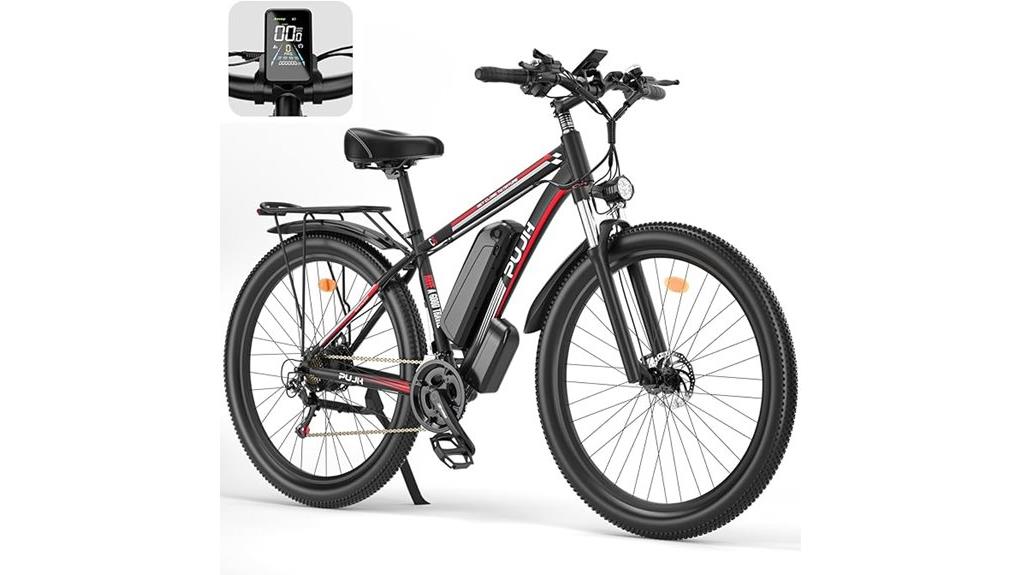

You’ll get a throttle-capable Class 3 e-bike with a 2,000W peak motor, 48V 840Wh removable battery, and brisk ~34 mph top speed; it’s built for fast commutes, loaded runs, and light off-road work. You’ll find immediate acceleration, five power levels, and sustained torque for climbs, plus 29" wheels and front suspension for stability. Brakes and rack fitment suit daily use, and assembly is straightforward — read on to see detailed specs, range tests, and buying considerations.
Some Key Takeaways
- The PUJH PU1 uses a brushless 2000W peak motor with ~60 Nm torque and throttle-capable Class 3 performance up to ~34 mph.
- A removable 48V 17.5Ah (840 Wh) battery delivers practical real-world ranges of roughly 30–80 miles depending on assist and terrain.
- The aluminum step-through frame, front suspension, 29" wheels, and wide tires provide stable high-speed handling and offroad versatility.
- Five power levels, immediate throttle response, and sustained torque yield brisk acceleration and confident hill climbing.
- Comes with cargo rack, integrated lights, USB display, and ~90% pre-assembly; check warranty and consider brake-pad matching.
Quick Verdict and Who the PUJH PU1 Is Best For
Cut through the specs: the PUJH PU1 is a powerful, throttle-capable Class 3 e-bike that delivers strong acceleration and up to 34 mph top speed thanks to its 2000W peak motor and 840 Wh battery. You’ll find commuter appeal in its cargo rack, lighting, and range that make daily routes efficient and confidence-inspiring. You’ll also exploit offroad versatility via wide 29" wheels, suspension, and a 21-speed drivetrain that handle trails and gravel without compromise. If you want speed, load capacity, and adaptable terrain performance, this bike gives you freedom to choose routes and maintain control under varied conditions. It’s especially well suited to riders who enjoy outdoor activities and need an adventure-ready step-through ebike.
Complete Specs at a Glance : Motor, Battery, Range, and Components
While the PUJH PU1 packs a lot under the frame, its core specs tell you exactly what to expect: a brushless peak 2000W motor delivering 60 Nm of torque and up to 34 mph, paired with a 48V 17.5Ah (840 Wh) removable lithium-ion battery that yields a practical 30–80 mile range depending on assist level and terrain. You get 21-speed gearing, front suspension, 29" wheels, disc brakes and a colorful LED display with USB. Battery management seems competent for longevity; the torque curve is tuned for usable thrust. Note component compatibility and weight distribution when customizing accessories. Consider carrying a reliable spare battery to extend longer outdoor rides.
Real-World Performance: Speed, Torque, Hill Climbs, and Handling
Often the PUJH PU1 surprises you with immediate acceleration thanks to its brushless 2000W peak motor and 60 Nm of torque, delivering brisk throttle response up to the advertised ~34 mph on flat ground. You’ll feel confident high speed stability from the 29" wheels and rigid aluminum frame; vibration is controlled, letting you maintain line choice. Throttle responsiveness is sharp across five power levels, aiding quick overtakes and controlled starts. Climbing steep grades, the motor sustains torque with predictable cadence; traction control from wide tires helps grip loose surfaces. Cornering feedback is direct — you’ll carve confidently without surprises. For riders who enjoy outdoor adventures, choosing the right motor power and torque balance is key to match riding style and terrain, especially when prioritizing ebike motor performance.
Ride Comfort, Brakes, Suspension, and Accessory Fit for Daily Use
Because the PUJH PU1 pairs a firm 6061 aluminum frame with front suspension and a shock-absorbing saddle, you’ll get controlled comfort on mixed surfaces without a plush feel—jolts are muted but transmitted enough to keep feedback precise. You’ll appreciate seat ergonomics that favor long-distance posture and efficient pedaling; the saddle absorbs mid-frequency bumps while the 7-inch seatpost travel lets you fine-tune posture. Hydraulic-like disc brakes deliver predictable stopping power and modulation for high-speed descents. Front suspension soaks chatter; tire and fender clearance handle mud and urban debris. Accessory fitment—rack, lights, phone mount—stays solid for daily freedom. For reliable braking performance on varied terrain, choose pads matched to your hydraulic-like disc brakes and riding style ebike brake pads.
Cost, Warranty, Assembly, and Whether You Should Buy It
If you’re weighing the PUJH PU1, factor its up-front value against the long-term savings from electric commuting: the 2000W class‑3 bike with an 840Wh (48V 17.5Ah) battery commands a mid‑to‑high price relative to basic e-bikes but delivers strong range (30–80 miles) and performance that justify the cost for regular riders. You’ll want a price comparison versus rivals with similar motor/tank specs. Expect 90% pre-assembly — DIY assembly skills make setup straightforward. Check the return policy and 1-year parts warranty; consider buying an extended warranty for peace of mind if you ride hard or remote. Trail riders should also carry trail maps when planning outdoor ebike adventures.
Some Questions Answered
Does the PUJH PU1 Support Pedal Cadence Sensors or Torque Sensors?
No — it doesn’t natively support torque sensors; it uses standard pedal assist via cadence-style sensing. You’ll get sensor compatibility for cadence-based PAS and throttle control, not true torque-based proportional assist. If you want torque sensing, you’d need an aftermarket controller and torque sensor retrofit, or a different model. You’ll retain full throttle modes, 5 assist levels, and pedal assist response typical of cadence systems, favoring simplicity and range.
Can the Battery Be Flown With on Airlines for Travel?
No, you generally can't fly with that battery in carry-on or checked baggage without special airline approval. Airline regulations restrict lithium-ion cells above about 100 Wh for standard carriage and require airline approval up to 160 Wh; your 48V 17.5Ah pack is roughly 840 Wh, far exceeding limits. You'd need freight shipping under hazardous-material rules or arrange special cargo transport, so plan logistics proactively to keep your freedom to travel.
Is There Smartphone App Integration for Display Customization or GPS?
No — there’s no dedicated smartphone app for deep display customization or native GPS mapping; you’ll get basic LED ride data only. You can expect limited app connectivity for firmware updates or telemetry via third-party dongles, but route sync and full map overlays aren’t supported out of the box. If you want freedom to plan and follow routes, use a phone mount with a mapping app and pair via Bluetooth/GPS accessories separately.
What Maintenance Schedule and Parts Availability Are Typical Long-Term?
You should follow regular service intervals: check brakes, bolts, tires and drivetrain every 250–500 miles, full tune and battery health check every 3–6 months, and replace consumables (pads, tires, chain) yearly depending on use. Expect battery lifespan of 500–1,000 cycles. Parts sourcing depends on dealer networks and online suppliers; OEM parts may be limited, so secure spares early. Keep records and use authorized service for warranty and long-term reliability.
Are Replacement Batteries and Compatible Chargers Sold Separately?
Yes — replacement batteries and compatible chargers are sold separately. You can buy a 48V 17.5Ah replacement battery and OEM or third‑party compatible chargers; make sure voltage, connector type, and BMS compatibility match. You’ll want a lockable removable pack for ease and a charger rated for the pack’s voltage and current to preserve range and cycle life. Buying OEM support or verified aftermarket parts keeps warranty and performance predictable.